

DPI Over Deals, Discipline Over Dreams
Why today’s venture managers must swap vanity mark‑ups for bankable cash returns. Capped off by a members-only LP AMA


The New North Star: Distributed to Paid‑In (DPI)
Institutional LPs have become laser‑focused on one metric: cash they can wire back to their investment committees. Paper gains feel good in bull cycles, but the past two years of flatlining IPOs and retrades have shown how quickly unrealised marks evaporate.
“Way too many investors talk about the deals they do, not the money they return.” - Jonathan Sibilia
Reserve Your Seat - LP AMA
A closed‑room, Chatham‑House session where you have the chance of asking Jonathan Sibilia anything you want to. No decks, no recording, no spin.
👉 Join the Community - spaces are available to community members to keep the discussion candid and exclusive.

On August 21st, we’re hosting a members-only LP AMA with Jonathan Sibilia, Partner @ Bullhound Capital and EUVC podcast’s guest on our Exit Strategies and their Role in VC episode. The LP AMA is free & for EUVC community members only. This is your chance to ask all the questions, challenge his views, and explore how venture fundraising must evolve in today’s new reality.
DPI Is Overtaking IRR as the Benchmark
Since 2022, investment committees at sovereign wealth funds, U.S. endowments, and European family offices have quietly re‑ordered their screening sheets: Distributed‑to‑Paid‑In (DPI) now appears above Internal Rate of Return (IRR). The trigger was painful: 90 % of 2021’s mark‑ups compressed when growth multiples normalised. Cambridge Associates subsequently published its 2024 VC Key Metrics Note, showing that almost half of top‑quartile TVPI funds slid to median once rankings were re‑run on DPI alone.
“If you’ve been at this for fifteen years and haven’t returned real capital, no glossy deck will fix that.”
Two lessons flow from this shift:
Cash beats confidence. Paper gains are increasingly discounted unless accompanied by interim distributions.
Emerging GPs must show a liquidity path- even if that means documenting planned secondary windows or earlier‑stage M&A scenarios.
The Mid‑Range Exit Is a Fund‑Maker
PitchBook’s five‑year exit database (2019‑2024) lists 2,318 tech M&A events. 47% cleared between $100 M and $300 M. Only one in ten topped a billion. Yet that mid‑range rarely makes TechCrunch headlines, leaving founders and junior VCs believing “real” success starts at unicorn status.
“Most exits happen between 100 and 300 million… It’s perfectly okay if you came in at 25 or 30 and sell for 250 or 300.”
Translating the numbers to fund math: a €60 M seed fund deploying €2.5 M into a €25 M pre‑money that sells for €250 M returns €25 M net- over 40 % of the entire fund in one cheque. Repeat that twice and you’re in the top decile of DPI performers without a single unicorn.
Early Exit Odds vs. Late‑Stage Dollars
Carta’s 2024 Private‑Market Liquidity Report puts ~30 % of successful exits in the immediate post‑Series A window. The dollar‑weighted picture is different: mega‑deals after Series C still account for roughly half of all exit value. This dual reality explains why some managers load reserves for follow‑ons while simultaneously pushing early portfolio companies toward strategic buyers. The goal is portfolio‑level bar‑bell liquidity- cash now, upside insurance later.
Engineering Liquidity: Why Two‑Thirds of LOIs Fail
Silicon Valley Bank’s Tech State of the Markets brief estimated that only 35‑40 % of executed Letters of Intent close. Common killers: option‑pool snarls, un‑audited SaaS metrics, and mis‑alignment between common and preferred shareholders.
“Two out of three LOIs never close.”
Investors who guide founders through quarterly “clean‑room” hygiene, scheduled data‑room updates, pre‑audit financials, and customer consent letters cut failure odds by half and compress diligence from 90 days to ~45.
Fund Size Discipline Beats Asset Gathering
Preqin’s European VC Scorecard found that sub‑€75 M 2012‑2016 vintages produced a median 1.8× DPI at year‑10, while vehicles above €150 M averaged 1.3×. Excess dry powder pushes partners into off‑thesis deals just to keep pace with deployment models pegged to management‑fee budgets.
“Seventy million is a great size for a two‑to‑three‑person team. Keep it lean.”
A practical ratio: one general partner per €25 M of initial cheque capacity is the threshold where conviction and bandwidth still intersect.
Differentiation ≠ Marketing Language
Every deck claims proprietary deal flow and an unrivalled network. Limited partners validate this with “Five‑Call DD”: they phone five trusted insiders. If your name doesn’t surface, your edge isn’t edge.
“If I call five smart people in your space and they don’t mention you, you don’t have an edge.”
Action items:
Publish anonymised funnel metrics (share of first‑call access, days from intro to signed term sheet).
Enlist portfolio founders to give unfiltered references during LP diligence.
Greed vs. Compounded Reputation
Founders who turn down €250 M strategic bids “to hold out for a unicorn” often discover later rounds on worse terms. Track‑record analysis by Notion Capital shows companies declining sub‑$300 M offers had a 38 % chance of never exiting at all. Conversely, funds known for pragmatic timing enjoy first‑look deal flow from serial founders who value aligned liquidity.
Secondary Liquidity as Talent Magnet
Survey data from AngelList and ESOP‑platform Ledgy reveal that employees in companies offering ≥ 10 % option liquidity by Series B stay an average 1.6 years longer. Allowing early secondary without tanking momentum requires cap‑table headroom and GP facilitation. Funds that systemise these programmes reduce founder churn and preserve option pools for future hires.
Founder, Not GP, Is Protagonist
“We’re not the kings of the land- we’re just courtiers.”
Whether it’s blocking an overpriced crossover round or nudging CEOs toward a non‑glamorous but business‑critical VP‑Finance hire, the highest‑ROI acts are often invisible. The reward? Founders call you first, before bankers, when real opportunities surface.
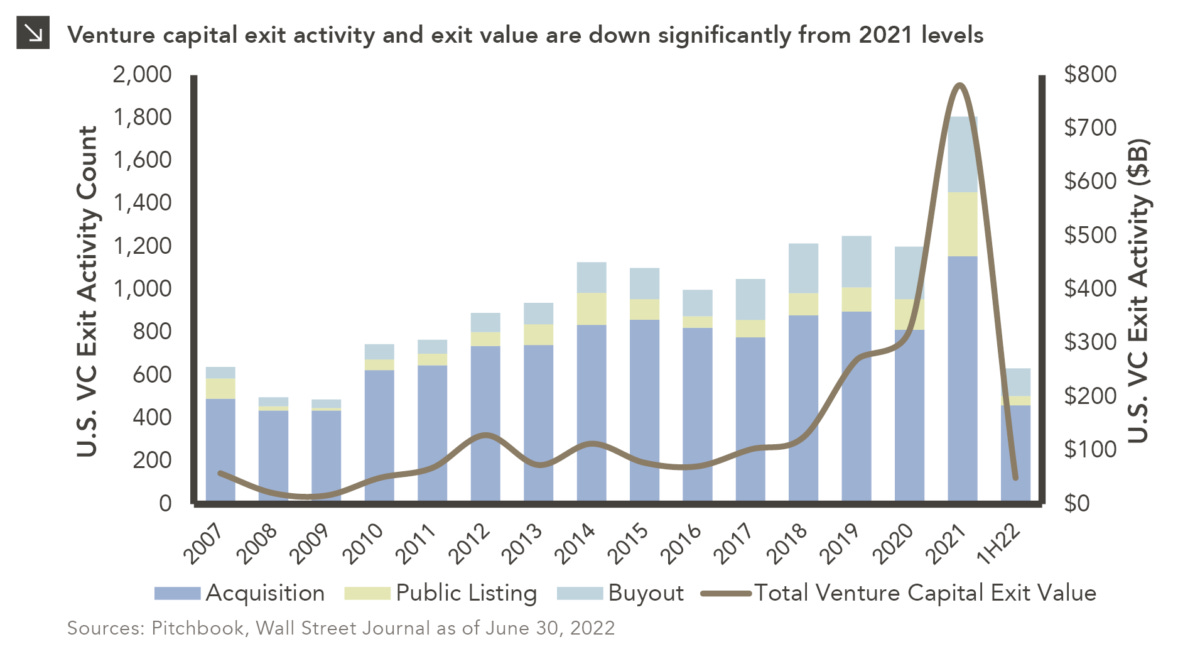
The visualisation from Marquette Associates highlights one blunt truth: after a record-breaking 2021, total VC exit value plunged and only began recovering in 2025, mostly via M&A, not IPOs. That supports today’s strategy shift:
Liquid outcomes now lean toward private strategic sales or buyouts, not public offerings.
The mid-market ($100M–$300M) remains the most reliable source of exit frequency, but not necessarily of aggregate value.
LP pressure to distribute is intensifying, making DPI a more important metric than previously thought.
Together, the image and article findings validate a pivot in strategy: build exit playbooks early; aim for realistic mid‑range outcomes; and size your fund to deploy capital and return it-not to chase scale without closure.
Market Insights
1. Exits Are Finally Picking Up- But Wealth Is Still Concentrated
Q2 2025 saw VC exit value climb back to $67.7B, the strongest quarterly total since 2021. That said, exit volumes remain well below peak, with fewer exits overall and liquidity still extremely concentrated.
2. IPO Markets Are Fragile- but Showing Green Shoots
Unicorn listings like Figma and Reddit pulled the public window open, yet most new companies delay IPOs, leaning on private equity and M&A for exits instead.
3. Mid‑Range Exits Dominate Count, even in 2025
Although public images of $1B+ exits dominate headlines, most real activity happens below that level. Recent datasets show ~45 % of tech exits fall in the $100M–$300M band, while billion+ deals account for only ~10 % of total count .
4. Dollar Value Still Flows Upwards
Higher‑value exits (> $1B) command the lion’s share of exit dollars even as they remain rare. LPs who rely solely on mid‑range outcomes may hit volume, but they need follow‑on and concentration to capture outsized return skew.
5. A Two‑Tier Market Is Emerging
Today’s venture industry is bifurcating: firms with access to AI, fintech, and spacetech lead the deal count and exit value, while many others face constrained exit windows and flat valuations.
6. Liquidity Pressure Is Now Strategic, Not Tactical
With LPs demanding distributions and fundraising bottlenecks persisting, secondary rounds and continuation vehicles are becoming mainstream ways to salvage returns without waiting for IPO liquidity.
7. Timing Is Everything: Early Exits vs Holding
Carta research shows ~30 % of exits close right after Series A, yet the few later-stage unicorns still pull the most capital. The smart strategy: engineer early exits while keeping exposure to rare upside.
8. Engineering, Not Hope
Silicon Valley Bank’s 2024 analysis shows up to two‑thirds of LOIs fail to close due to due diligence gaps- uncovered liabilities, cap‑table misalignments, or strategy misfits.
9. Fund Size Must Match Bandwidth
Data from Preqin and Bain indicate that smaller funds (sub‑€75M) outperform larger peers on DPI and IRR thanks to sharper deployment discipline and less capital drag
Curious to learn about what Jonathan thinks about the current market?
Join our exclusive AMA session on August 21st and ask your questions live.

Free- for EUVC community members only.
.As venture capital markets recalibrate from the exuberance of the bull run to today's disciplined realism, Distributed-to-Paid-In (DPI) emerges as the essential benchmark guiding investment decisions. While large unicorn exits continue to dominate headlines and capture significant industry dollars, fund managers seeking consistent performance must pivot toward reliable mid-market liquidity outcomes. Repeatable exits in the $100M-$300M range underpin top-decile DPI returns, demonstrating that disciplined realism outperforms unicorn fantasies.
This strategic pivot toward DPI is more than cautious pragmatism; it's about actively engineering liquidity rather than passively hoping for it. Silicon Valley Bank highlights that roughly two-thirds of LOIs fail due to diligence oversights or stakeholder misalignment. Success today depends on proactively managing portfolio hygiene, regular "clean-room" audits, transparent cap-table management, and clear strategic alignment, significantly improving the likelihood of bankable returns.
Additionally, the emerging two-tier market demands tailored liquidity strategies. Funds in sectors like AI, fintech, or spacetech might pursue a balanced approach, mixing mid-market exits with strategic bets on unicorn opportunities. However, venture funds without sector-specific tailwinds must deliberately size their funds to match team bandwidth and achievable liquidity expectations. Preqin data confirms smaller, disciplined funds consistently outperform larger vehicles that chase scale without closure.
Secondary liquidity mechanisms are now critical, not optional, for managing founder and employee alignment throughout investment lifecycles. AngelList and Ledgy data highlight that structured secondary offerings boost employee retention and stability, enhancing a company's attractiveness for strategic acquisitions.
Differentiation in today's market must transcend marketing language. Genuine edge lies in transparent funnel metrics, candid founder endorsements, and proven exit track records. Managers committed to transparency around DPI and liquidity strategies signal strongly to LPs who prioritise realised returns over potential ones.
Today's venture landscape requires disciplined execution over dreams. Prioritising DPI means choosing liquidity certainty, proactively engineering outcomes, and maintaining pragmatic fund sizing. Venture managers embracing this discipline won't merely survive: they will thrive, consistently attracting LP capital and securing lasting success.