


By Cathy White, CEO of CEW Communications, and David Cruz e Silva, Co-founder of EUVC and EUVC Communications
European tech is entering a phase where clarity matters more than momentum. Capital has been tighter, expectations higher and the distance between those who are understood and those who are not has quietly widened.
This divide is no longer primarily about technology. Many of the most impressive products in Europe struggle to gain traction, while others, sometimes technically less ambitious, cut through with surprising ease.
The difference increasingly comes down to one thing: clarity.
The companies making progress are not necessarily the loudest or best funded. They are the ones that can explain, again and again, why they matter to customers, to investors, to policymakers and, increasingly, to machines.
That’s not branding. That’s communications and it’s becoming core infrastructure for European tech.
A media landscape that has moved on
Europe’s tech media environment has changed profoundly and mostly quietly.
Over the past few years, familiar titles have closed, consolidated, or shrunk. TechCrunch withdrew from Europe. Business Insider reduced its footprint. Digital Frontier disappeared almost as quickly as it arrived. The Next Web was effectively reborn through acquisition. Silicon Canals and EU-Startups were both acquired.
This has not created a vacuum so much as a re-ordering. It raises the question: who is there to share your news with?
Established publications such as Sifted, Tech.eu and EU Startups continue to play a critical role. At the same time, influence has dispersed across podcasts, livestreams, newsletters, Substacks, WhatsApp groups and individual journalists whose personal reach now rivals that of entire newsrooms. More and more people are becoming content creators.
Media platforms such as EUVC, focused on deeply nuanced, European-first thought leadership rather than volume and scoops, play a growing role in translating complexity into shared understanding.
European tech media is rapidly evolving - this is a good thing.
The result? There’s more noise, more chances and an interesting 2026 ahead.
For founders and investors, this means the old ambition of “getting coverage” is no longer enough. There is no single outlet that confers legitimacy by default.
Now more than ever, European companies and VCs need to understand where attention actually lives, show up consistently across formats, and speak with enough coherence that they sound credible wherever they appear. Oh - AND - try new things!
This is not about chasing every channel. It is about being recognisable, and recognisably thoughtful, across the ones that matter.
Trust cannot be delegated
One lesson stands out across European markets: trust accumulates slowly and disappears in the blink of an eye.
It does not come from a funding announcement or a splashy product launch. It comes from repetition, coherence and credibility over time. This is especially true in Europe, where audiences tend to be sceptical of hype and impatient with exaggeration.
As a result, more companies are building their own communications capability alongside traditional PR. Founder voices are becoming more prominent. Owned channels such as newsletters, blogs, long-form thinking, etc., are being treated less as marketing add-ons and more as strategic assets.
This does not mean every founder needs to become a content creator. It does mean that relying entirely on external platforms or occasional media hits is increasingly risky.
Owning your narrative is no longer optional. It is how continuity is maintained when platforms change, outlets disappear or algorithms shift.
When machines decide who matters
Another change is harder to see but impossible to ignore.
People are no longer just searching; they are asking. AI-driven tools increasingly shape how information is discovered, summarised and prioritised. These systems favour sources that appear authoritative, consistent and well-attributed.
The implications are clear. Credible media coverage matters more, not less. Repeated association with expertise compounds. Being quoted as a real person with a clear point of view carries weight.
Communications is no longer only about reputation among humans. It now affects whether a company is visible at all in the systems that increasingly mediate attention.
For European tech, this should be an advantage. Depth, substance and long-term thinking are strengths of the ecosystem, but only if they are embraced, and articulated clearly and repeatedly.
From service provider to strategic partner
This is where many companies still struggle.
Transactional approaches to communications, brief in, press release out, short-term spike, rarely deliver lasting value. They can be useful at certain stages, but they do not build narrative resilience.
The organisations that navigate growth more effectively tend to treat communications partners as extensions of the internal team. They share context, not just messaging. They think in systems, not announcements.
This matters because narratives are cumulative. Speed matters. Consistency across markets and growth stages matters. And when things change, communications need to adapt without starting from zero.
In this sense, communications begins to resemble infrastructure: invisible when it works, painfully obvious when it does not.
What comes next
A few trends seem unavoidable.
The media will continue to fragment, but trust will become more valuable. Founder voices will matter more than corporate ones. Owned and earned media will increasingly reinforce each other. And communications will shape discoverability, not just perception.
The companies that perform best will not be the most aggressive. They will be the clearest, even when markets are uncertain and narratives are hard to sustain.
Five practical steps
1. Build a narrative that survives format changes. If your story only works in a pitch deck or a press release, it is fragile. Strong narratives travel across interviews, investor conversations, social platforms and AI summaries.
2. Treat owned content as an asset. Like any product, it needs an audience, cadence and point of view. Publishing only when there is news leaves value on the table.
3. Redefine what “good PR” looks like. It is less about logos and more about being cited, recognised and trusted before attention is urgently needed.
4. Optimise for credibility rather than virality. In most cases, depth beats reach. Investors, customers and machines all reward substance.
5. Work with partners who think long-term. The most effective communications advisors behave as if they have a stake in the outcome. They challenge weak narratives, stay close during uncertainty, and think beyond the next headline.
A closing thought
European tech has never had a storytelling problem. It has a consistency and discipline problem.
It does not fail for lack of ideas, but when those ideas are poorly explained, inconsistently articulated, or left to chance.
In an environment shaped by fragmented media and AI-driven discovery, the advantage will belong to companies that can explain themselves clearly and repeatedly, not just loudly, to people and to machines alike.
Communications is not a “nice to have” for good times, nor an expendable cost when conditions tighten.
It is the core infrastructure for the next phase of European tech.
For leaders navigating this shift, clarity can be built deliberately. If this resonates, the conversation is worth continuing - get in touch with us.
The EUVC Awards - Your Last Chance to Nominate
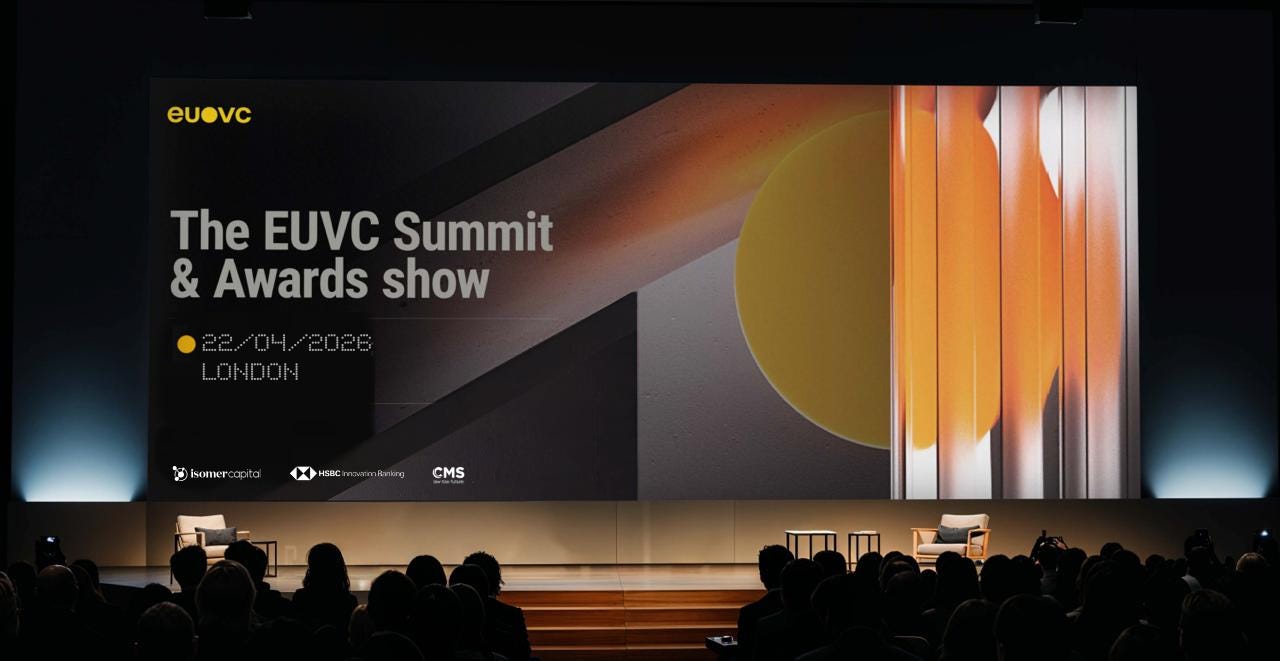
Today is the final day to nominate for the EUVC Awards.
The EUVC Awards celebrate the people and firms shaping Europe’s venture ecosystem — the investors, managers, and builders backing the companies defining the next generation of innovation.
From standout investors and emerging managers to ecosystem builders and value-creating exits, the awards recognise the individuals and teams pushing the European venture landscape forward.
If there is someone whose work deserves recognition, this is your last chance to nominate them.
Submit your nomination today and help us spotlight the people building the future of European venture.