

EUVC Live at GoWest: Europe’s Sovereignty Stack
Capital, energy, defence, and the long-term architecture of Europe's future
Hi friends 👋
Today’s edition is a special editorial dedicated to EUVC Live at GoWest, a format co-designed with the GoWest - Nordic Capital Forum team, where the Nordic innovation ecosystem’s brightest minds — from founders and deep-tech leaders to global investors and industry representatives — convened in Gothenburg for thought-provoking dialogue and decisive exchange.
Across talks, fireside chats and curated conversations, a surprisingly consistent diagnosis emerged: Europe doesn’t lack talent, ideas, or even savings. What it lacks is an aligned architecture of capital, incentives, and execution, strong enough to turn capability into ownership and to channel abundant capital into sustained deep-tech growth.
In this confluence of visionaries and builders, EUVC Live at GoWest didn’t just reflect the state of European venture. It challenged it, spotlighting not only what exists, but what must be built next.
We begin with the LP and policy layer. Philippe Tibi (The Tibi Initiative, French Ministry for the Economy, Finance and Recovery) lays out the case for a united European LP strategy, and we go deeper on what it would take to make that real with Chris Elphick (BVCA). We also explore what “good” long-term capital actually looks like in practice with Christina Brinck (Volvo Group VC), Daniel Keiper-Knorr (Speedinvest), and Joe Schorge (Isomer Capital).
From there, we examine public capital as part of the system. Michiel Scheffer (EIC) frames public funding as market-completion for first-of-a-kind innovation, and Adem Yakisirer (EIF) unpacks why the EIF exists, what it’s designed to do, and how it shapes the venture ecosystem, followed by a live conversation with Mia Grosen (Superseed) and our very own Andreas Munk Holm.
The focus then shifts to the sovereignty stack itself: energy, minerals, and industrial resilience. Danijel Višević (World Fund) argues Europe has to turn crisis into innovation again. Heidi Lindvall (Pale Blue Dot) and Narina Mnatsakanian (Regeneration VC) push the conversation beyond performance toward responsibility and durable impact. Dr. Isabella Fandrych (Nucleus Capital) explores how biology could reshape access to critical minerals, while Jordan Billiald (IQ Capital) makes the case for nuclear returning as a serious climate-and-sovereignty lever. Moritz Jungmann (FEV) ties it together through the lens of energy security as the foundation for strategic autonomy.
We also confront the hard shift happening in defence. Karl-Christian Agerup (NIF) outlines NATO’s role in backing strategic technologies, and Nicholas Nelson (Archangel Ventures) with Sebastian von Ribbentrop (Join Capital), tackle the uncomfortable reality that Europe wants defence outcomes, but still hesitates to say “defence.”
Furthermore, we look at Europe’s edge in frontier domains: Olivier Tonneau (Quantonation) on quantum leadership, Jeppe Høier (EUVC Corporate) on what corporate venturing takes when incentives are real, Paolo Pio (Exceptional Ventures) on separating science from fiction in longevity, and Fergus Bell (The Players Fund) with Prashant Agarwal (Scandian) on sports as a modern business and platform asset class.
Last but not least, please join us in congratulating Olivier Tonneau and his co-founder and partner Christophe Jurczak, PhD (watch an episode featuring him here), on the successful launch of Quantonation II, backed by €220 million in capital commitments to industrialise quantum and physics-based systems.
As always, thank you for reading, sharing, and pushing the conversation forward. It genuinely makes this community stronger.
Hope you enjoy,
with 💖
David & Andreas

EUVC Awards 2026: Nominations Are Still Open
As European venture continues to mature, scale, and professionalise, the way we celebrate excellence needs to keep pace. Venture in Europe is now operating at a new level with greater institutional involvement, more capital at work, and a stronger shared commitment to the ecosystem we’re all helping to shape.
That’s the context the EUVC Awards are built for.
They spotlight exceptional venture firms, investors, and ecosystem contributions across Europe. But recognition only matters when it’s earned through a process that is credible, fair, and grounded in a real-world context. Excellence shouldn’t be judged in a vacuum. It must be viewed through the lens of scale, mandate, strategy, and responsibility.
For 2026, we’ve made thoughtful updates to ensure the awards continue to reflect the reality of European venture today.
Nominations close on March 6th. If you haven’t submitted yours yet, this is your moment.
Help shape what excellence in European venture truly means.
Table of Contents
EUVC Live at GoWest – Nordic Venture Capital Forum
The Case for a United European LP Strategy
The New European Sovereignty Stack: Energy, Minerals, Compute
How Europe Turns Crisis Into Innovation and Why We Must Do It Again
What Great Looks Like in Venture When Performance Isn’t Enough
The Urgent Need for European Energy Sovereignty And How We Get There
Europe Wants Defence Tech Without Saying “Defence”
The Outlook for European Capital Sovereignty
Podcasts of The Week
Fund Modelling in VC: Portfolio Construction & Decomposition
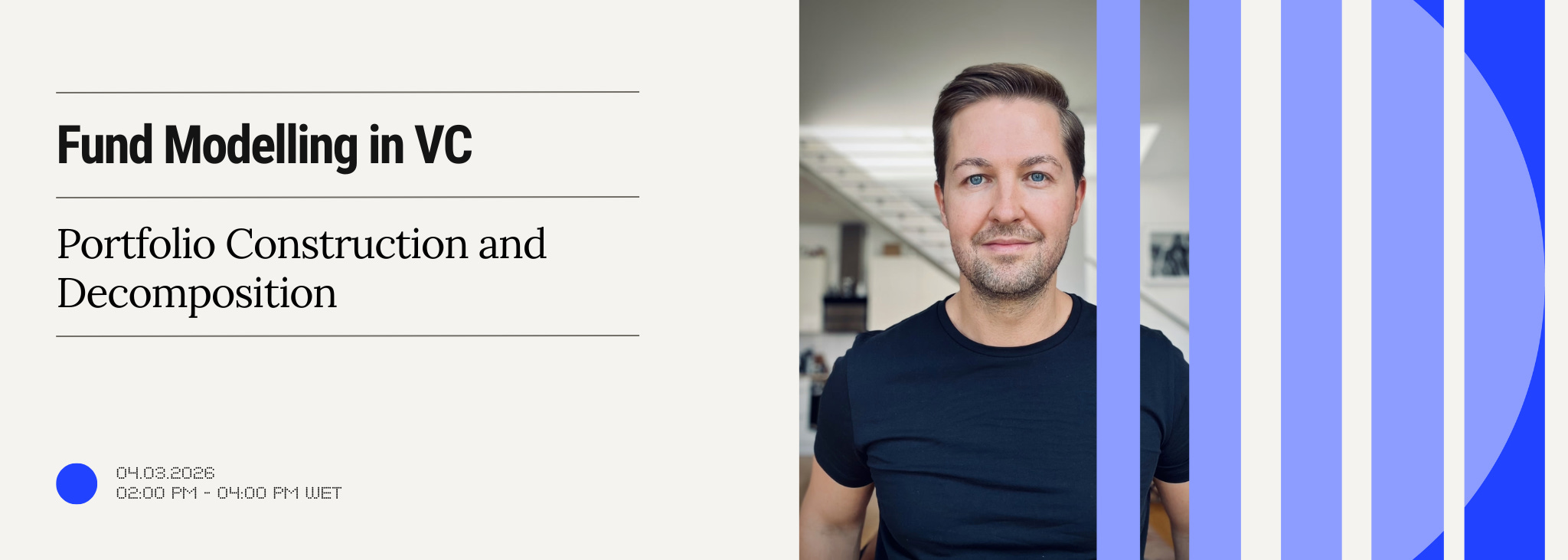
Virtual | Wednesday, March 4 | 02:00 PM - 04:00 PM GMT
If you’re building or managing a venture fund, your returns are shaped long before the exits happen. In this advanced 2-hour online masterclass, you’ll sharpen your ability to design, stress-test, and optimise your portfolio through better construction and decomposition.
You’ll learn how to structure entry and follow-on strategies, track capital deployment over time, simulate write-offs and exits, and model key performance metrics like TVPI, DPI, RVPI, and NAV with greater precision. We’ll focus on practical decision-making, real-world trade-offs, and dynamic asset valuation—so you can assess whether your strategy is truly set up to deliver.
Ideal for emerging fund managers, established VCs, family office and CVC professionals, and active HNIs who want to strengthen their fund modelling and make more informed portfolio decisions.
Get 50% off (for EUVC Academy members only). Join here.
European Competitiveness & LP Strategy
The Case for a United European LP Strategy
At EUVC Live at GoWest, introduced by our very own Andreas Munk Holm, one question framed the discussion:
How does Europe mobilise its own capital to secure its technological future?
The shared conclusion was clear: Europe doesn’t lack talent, innovation, or savings. What’s missing is coordination.
Professor Philippe Tibi (The Tibi Initiative, French Ministry for the Economy, Finance and Recovery) made the macro case: Europe holds €35T+ in household assets, yet its champions too often scale under foreign ownership. The issue isn’t capital scarcity — it’s allocation. Venture and tech need to become core institutional assets, not side bets, both for returns and sovereignty.
Chris Elphick (BVCA) and Professor Tibi addressed mobilisation: regulatory conservatism, fragmented mandates, and risk aversion keep institutional allocations near zero in many European markets. If Europe wants the upside, capital has to move.
→ Tune in: Europe’s Structural Constraint: Architecture, Not Ambition
Christina Brinck (Volvo Group VC), Daniel Keiper-Knorr (Speedinvest), and Joe Schorge (Isomer) explored venture from the allocator lens: power laws, patience, and cycle diversification. Venture isn’t optional exposure — it’s infrastructure for technological participation.
Michiel Scheffer (EIC) reframed public capital as market completion, especially in deep tech and growth gaps. Public capital enables where private markets hesitate.
→ Tune in: The Role of Public Capital in European Venture Outcomes
Finally, Adem Yakisirer (EIF), outlined EIF’s role as anchor and stabiliser across 1,600+ managers, and in a candid fireside Q&A with Mia Grosen (Superseed), the conversation sharpened around dependency on public anchors, and what it would take to build a more self-sustaining LP ecosystem.
→ Tune in: Catalyst or Competitor? Why the European Investment Fund (EIF) Exists and How It Shapes Venture
Europe’s constraint isn’t innovation. It’s capital coordination.
🎧 Listen on Apple Podcasts or Spotify, and if you’re building or investing in AI, this one is worth queueing with chapter markers.
The New European Sovereignty Stack: Energy, Minerals, Compute
Europe Doesn’t Break. We Reinvent.
Europe’s identity isn’t stability but reinvention. From coal and steel integration to union-building under pressure, Europe has historically moved forward by coordinating in moments of crisis.
Danijel Višević (World Fund), set the frame: today’s “polycrisis” — war, climate, fractured supply chains, AI disruption, energy insecurity — isn’t proof of decline. It’s another historical inflection point. Europe either fragments under pressure or collaborates its way into relevance again.
→ Tune in: How Europe Turns Crisis Into Innovation and Why We Must Do It Again
Heidi Lindvall (Pale Blue Dot), challenged the venture industry’s self-image. Performance is the entry ticket, but performance alone isn’t excellence. She offered a sharper equation:
Success = Performance × Trust.
Trust is built through brand, values, and measurable impact. Capital is not neutral. Every investment is a directional bet on the kind of future we scale.
Joining Heidi Lindvall in a fireside conversation, Narina Mnatsakanian (Regeneration VC), grounded the discussion in LP reality. Pension funds seek returns, but pensioners seek something larger: stability, resilience, and a world that still functions when they retire. The purpose of capital is not only growth. It is durability.
→ Tune in: What Great Looks Like in Venture When Performance Isn’t Enough
Dr. Isabella Fandrych (Nucleus Capital), brought applied deep tech into the room: microbes capable of extracting critical minerals. Biology as industrial infrastructure. Biology as supply chain resilience. If Europe wants sovereignty, it must rethink materials from the molecule up.
→ Tune in: Can Biology Replace Mining? The Future of Critical Minerals
Jordan Billiald (IQ Capital), reframed nuclear energy as practical infrastructure rather than ideology. If Europe wants decarbonisation, baseload power, industrial competitiveness, and sovereignty, nuclear becomes less a political debate and more a strategic tool.
→ Tune in: The Case for Nuclear: Climate, Sovereignty and Europe’s Industrial Future
Moritz Jungmann (Future Energy Ventures), highlighted the real bottleneck. Europe has built generation capacity. The constraint now is grid modernisation and capital deployment speed. The challenge isn’t producing electrons — it’s orchestrating and moving them efficiently.
→ Tune in: The Urgent Need for European Energy Sovereignty And How We Get There
Europe’s problem isn’t ambition. It isn’t talent. It isn’t ideas. It’s execution velocity.
🎧 Listen on Apple Podcasts or Spotify, and if you’re building or investing in AI, this one is worth queueing with chapter markers.
Europe Wants Defence Tech Without Saying “Defence”
Is Europe finally getting serious about defence? And if so, can European capital rise to the challenge of building true European champions?
Karl-Christian Agerup (NATO Innovation Fund (NIF)) set the context: Europe has underinvested for decades in critical capabilities. At NIF’s inception, Europe represented less than 10% of global deep tech spending. Defence integration was fragmented, procurement was slow, and growth capital was thin.
→ Tune in: Building Technological Sovereignty: Inside the NATO Innovation Fund
NIF’s €1 billion mandate, backed by 24 NATO nations, aims to change that — not just through direct investment, but by crowding in capital, accelerating procurement pathways, and connecting startups to operational environments.
Two structural issues kept surfacing: procurement and data ownership. Then the debate sharpened.
Nicholas Nelson (Archangel Ventures), asked the uncomfortable question: Is Europe’s “defence boom” real, or are VCs simply wrapping themselves in a Ukrainian flag?
Defence-first companies build clearer capabilities, align directly with the warfighter, and historically outperform. Trying to optimise for defence and commercial markets simultaneously can dilute execution. Palantir and SpaceX, he argued, built defence-first before expanding.
Sebastian von Ribbentrop (Join Capital), countered with European reality. Procurement cycles are slow, and civil markets are fragmented; for early-stage deep tech, dual-use is often a survival mechanism. The same core technology can serve multiple customers, and defence demand can create order books large enough to avoid excessive dilution.
Europe’s strength, he suggested, may lie more in subsystems than in full-stack platforms. The deeper tension: will European defence champions ultimately have to pick a flag? Growth capital remains structurally stronger in the US, and many “European” champions carry US-heavy cap tables. Without a stronger European late-stage ecosystem, ownership drifts.
Europe is taking defence seriously. Now the capital stack and procurement architecture must catch up — or sovereignty remains a slogan.
→ Tune in: Defence Beyond the Virtue Signalling
🎧 Listen on Apple Podcasts or Spotify, and if you’re building or investing in AI, this one is worth queueing with chapter markers.
The Outlook for European Capital Sovereignty
Europe doesn’t lack research, talent, or technical depth. What’s at risk is capital scale.
Olivier Tonneau (Quantonation) made the case: Europe supplies roughly 40% of the world’s deployed quantum computers. The startups are strong. The science is world-class. But financing dynamics have shifted dramatically — with the majority of large-scale rounds flowing to US companies. The problem isn’t capability. It’s late-stage firepower.
Jeppe Høier (EUVC Corporate) shifted the lens to corporates: 25% of global VC volume involves corporate capital and the most likely acquirer of a startup is a corporate. Yet the average lifetime of a CVC unit is just 3.7 years. Without a clear mandate, governance, and long-term strategy, corporate venture becomes fragile. If Europe wants deep tech exits, corporates must act as durable strategic allocators.
→ Tune in: The Path to Corporate Venturing Success
Paolo Pio (Exceptional Ventures) expanded the deep tech frame into health and longevity. Biology is now moving at the speed of software. Genome sequencing, AI-driven diagnostics, personalised medicine — health tech is becoming one of the fastest-scaling deep tech frontiers. But as capital floods in, separating science from speculation becomes critical.
→ Tune in: Living forever: Separating Science from Fiction in Longevity
From another angle, Fergus Bell (The Players Fund) and Prashant Agarwal (Scandian) explored sport as commercial infrastructure. Athlete-led funds, rights holders, AI-driven performance analytics — sport is becoming a distribution engine and real-world testbed for deep tech. IP, data, and global fan bases are no longer marketing assets; they’re venture multipliers.
→ Tune in: Sports as a Business — an insider’s view
Europe’s constraint isn’t scientific leadership. It’s capital durability and strategic scale.
🎧 Listen on Apple Podcasts or Spotify, and if you’re building or investing in AI, this one is worth queueing with chapter markers.

Private Off-Site for Corporate Venture Leaders | 11–14 May | Piedmont
We are hosting a private, invitation-only off-site for corporate venture leaders and senior executives in the Piedmont region of Italy.
Designed as a deliberate alternative to traditional conferences, the off-site brings together a small group of experienced leaders for thoughtful dialogue, peer exchange, and reflection. Set in Piemonte’s wine country, the experience combines guided vineyard walks, unhurried meals at family-run wineries, and intimate fireside conversations in a private residential setting that fosters trust and candour.
This is a rare opportunity to step back, connect with peers, and reflect on leadership, strategy, and long-term perspective.
Learn more and request to join below.
This Week in European Tech with Dan, Mads and Eyal
In this episode of Upside, Dan Bowyer and Mads Jensen of SuperSeed are joined by Eyal Malinger, Managing Partner at Resurge Growth Partners, to unpack a genuinely strange week in global tech — one that felt less like a market cycle and more like a systems shift.
China unveils humanoid robots that look disturbingly battlefield-ready. Anthropic tries to draw moral lines in defence AI. Peter Steinberger leaves Europe almost as fast as he went viral. Munich feels less “security conference” and more “Europe, wake up.” Meanwhile, billion-dollar AI seed rounds and quantum mega-funds quietly signal that the frontier is accelerating again.
This isn’t just a tech moment.
It’s power, procurement, capital allocation, and deterrence — all moving at once.
Key takeaways from the episode:
▪️ China’s humanoid reveal wasn’t theatre — it was a signal. Hardware capability is accelerating, prices are collapsing, and China already dominates humanoid shipments by volume. The uncomfortable question: if this is prime-time TV, what’s behind closed doors?
▪️ The brain may be American. The metal increasingly isn’t. Autonomous hardware changes deterrence math. If political cost falls, escalation barriers fall with it.
▪️ Anthropic vs Palantir is the ethics tension in real time. Anthropic says no autonomous kill decisions. Palantir argues technological superiority preserves peace. Can you sell into defence budgets while claiming moral distance — or is that trying to have it both ways?
▪️ Defence AI is now procurement-level real. This isn’t abstract alignment debate. It’s contracts, budgets, and battlefield deployment cycles.
▪️ Talent gravity remains structural. Peter Steinberger’s rapid move to OpenAI isn’t anecdotal — it’s ecosystem physics. Platform scale, ambition density, regulatory speed, and capital depth still pull west.
▪️ AI inside venture: hygiene or edge? Workflow automation (notes, CRM sync, summaries) is impressive — but it’s table stakes. Competitive alpha still lives in brand, trust, niche positioning, and physical presence.
▪️ Venture is bifurcating. Billion-dollar platform funds on one side. Highly specialised micro-VCs on the other. The messy middle looks increasingly exposed.
▪️ Munich felt different. Defence budgets are rising fast across Europe. But sovereignty now extends to cap tables. Can European militaries rely on defence startups backed by American capital? The US has always asked this question. Europe is only now starting to.
▪️ Europe’s biotech strength is real, but scaling remains the bottleneck. Strong Phase III psilocybin data. Promising glucose monitoring breakthroughs. The science is here. Capital retention and speed are harder.
▪️ A billion-dollar AI seed round in Europe would’ve been unthinkable five years ago. Now it’s reality. Capital is concentrating heavily at the frontier while competition below it intensifies brutally.
🎧 Listen on Apple Podcasts or Spotify, and if you’re building or investing in AI, this one is worth queueing with chapter markers.
Join the EUVC Summit 2026
📅 22/04/2026 |📍 London
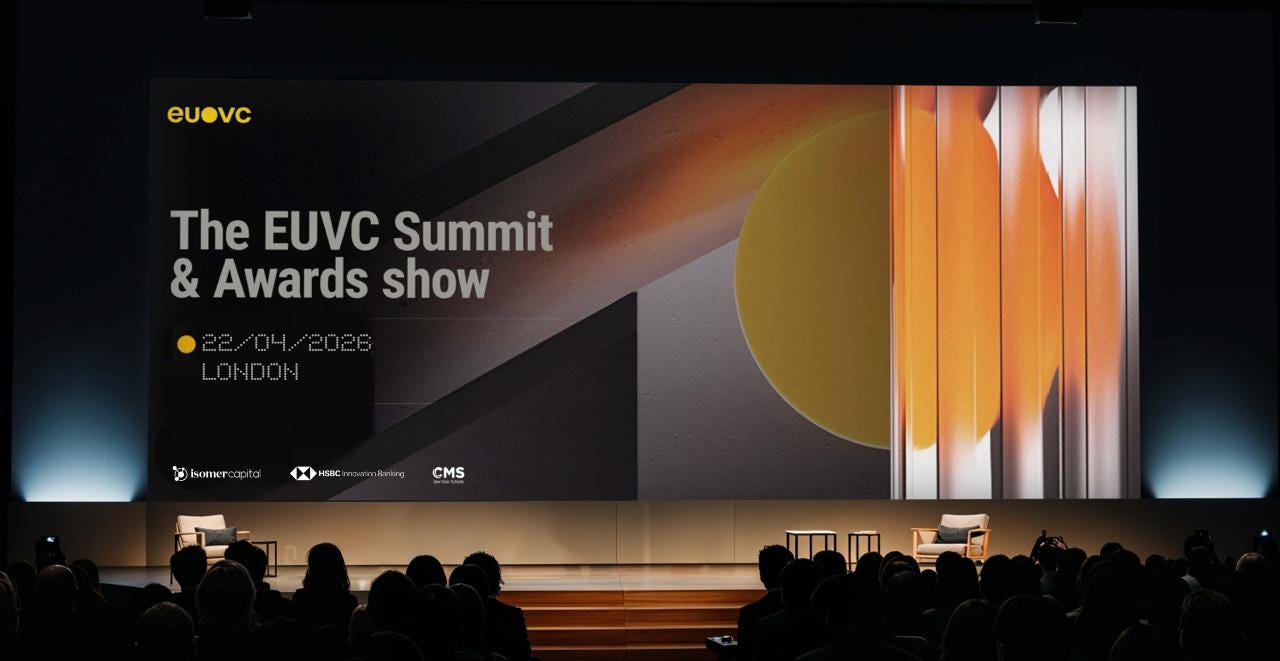
Europe’s builders take the stage.
The EUVC Summit returns with founders, operators, VCs, and LPs focused on one question: how Europe wins.
From what it really takes to build category-defining companies in Europe, to how capital, conviction, and long-term alignment must evolve to compete globally — this is a working room, not a trends conference.
More details coming soon.
[Webinar] Is Luxembourg right for you? | 18 March, 12-1PM CET, Online
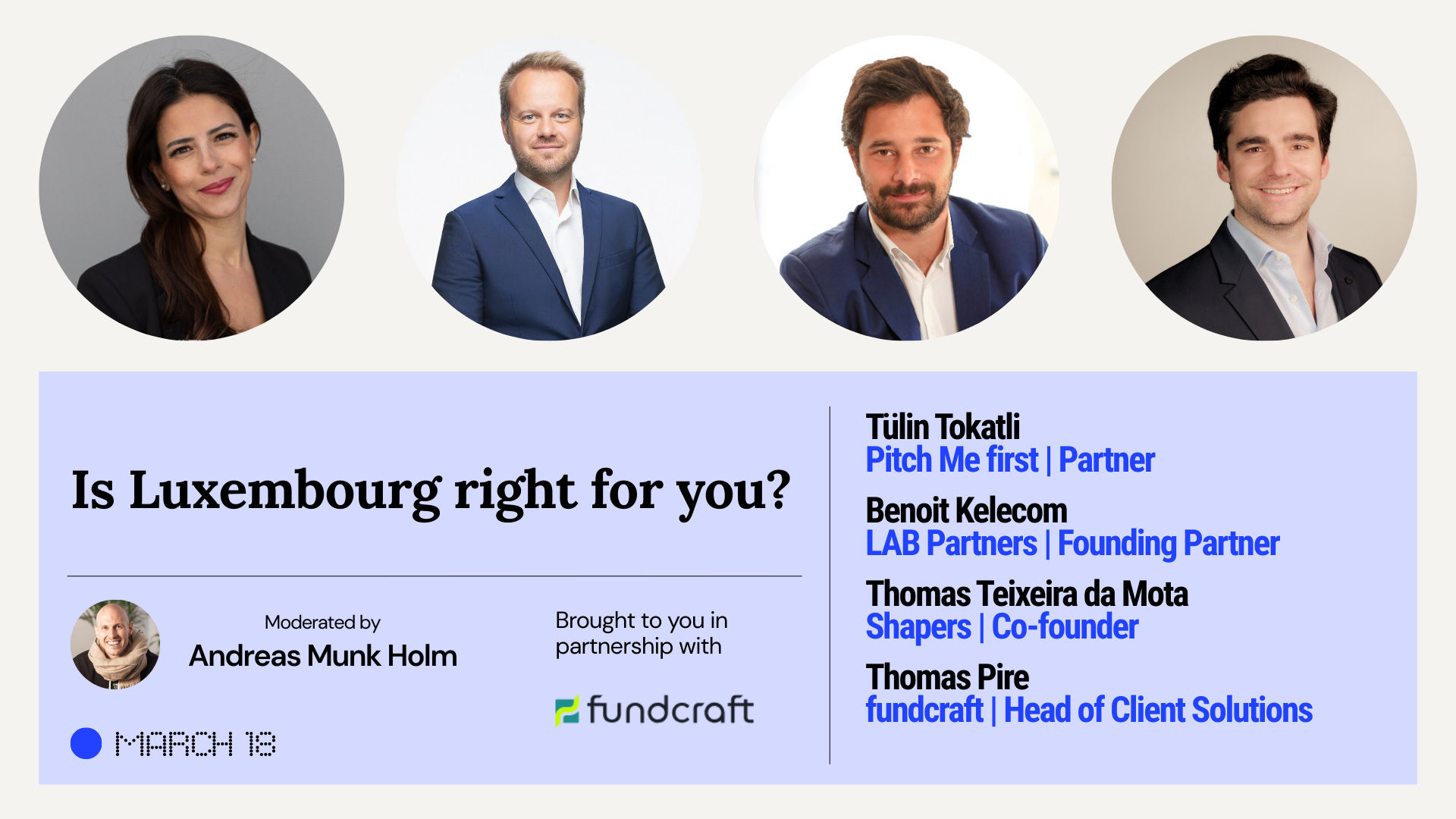
Brought to you in partnership with Fundcraft, join leading fund managers and operators for a candid discussion on whether Luxembourg is the right jurisdiction for your fund. Our expert panel will break down the practical realities—from structuring and regulation to operations and scaling—to help you understand when Luxembourg makes sense and when it doesn’t. Expect real-world insights, clear trade-offs, and actionable takeaways for emerging and established fund managers alike.
A small step toward better fund models (for all of us)
We’ve been digging deep into fund modelling through masterclasses, podcasts, and countless GP/LP conversations. One thing is clear: everyone’s wrestling with similar challenges, but almost nobody talks about them openly.
So we’re pulling together a shared snapshot for the whole community. Not an ask, just something we’re building together so we can all get a clearer picture of where the real friction points are in fund modelling today.
You can read about it here, but more importantly, please add your voice 👇.
We’ll gather the themes and share them with everyone. No fluff, just continuously striving to raise the bar and giving Europe’s venture ecosystem the signal it’s been missing.
Grateful to be building this with you all.
Mont Blanc Retreat 2026 🏔️

Join us in the French and Italian Alps for a small, carefully curated gathering in Piedmont and Chamonix, co-hosted with Paolo Pio (Exceptional Ventures) and Itxaso del Palacio (Notion Capital).
We’re bringing together a handful of thoughtful builders and investors for a few days away from the usual tech rhythm. Expect a balanced mix of guided treks and genuine downtime — mountain walks through spectacular scenery, long lunches, fireside conversations, and proper rest. And yes, for those who feel like it, even a bit of ice climbing.
You set your own pace. Push yourself physically, lean into deeper conversations, or simply breathe and take it all in.
There are no panels and no pitches. Just good people, honest dialogue, and space to reflect on the road ahead — and who you want to walk it with.
We’d love to have you join us.