

Power, Incentives, and Europe’s Next Wave of Innovation
What really drives outcomes in venture, and where Europe is placing its boldest bets.
Hi friends 👋
This week, we explore the intersection of power, incentives, and innovation from who controls capital allocation and how IC dynamics shape outcomes, to the new wave of ambition emerging across robotics and consumer AI.
We start with Debbie Wosskow OBE, Chair of the UK’s Invest in Women Task Force, for a data-driven conversation about where venture capital actually flows and why gender equity is ultimately a performance question, not a PR exercise. The discussion goes deep into institutional incentives, IC dynamics, and what truly shifts outcomes.
For LPs, we share a pitch episode with Pedro Ribeiro Santos of Armilar, unpacking a 25-year Iberian franchise built around DPI, governance continuity, and disciplined early-stage investing.
With Alex Dang, co-author of The Venture Mindset, we explore whether corporates can adopt venture logic and in some cases out-execute VCs in the AI era. It’s a sharp look at speed, incentives, and why most “AI strategy” fails before it starts.
We also spotlight two exciting funding rounds — two very different companies, both signaling the scale of ambition emerging across Europe. Allonic raised $7.2M, the largest pre-seed round in Hungary to date, to rethink how robotic hardware is built from the ground up. And pet insurance platform Lassie announced a $75M Series C, one of the largest European insurtech rounds of the past year.
Finally, we share updates on our community initiatives designed to raise the bar across Europe’s venture ecosystem, including our advanced masterclass series on VC fund modelling, our upcoming webinar with Fundcraft on whether Luxembourg is the right jurisdiction for your fund, and our private off-site in Piedmont for corporate venture leaders seeking deeper peer exchange and strategic reflection.
As always, thank you for reading, sharing, and pushing the conversation forward. It genuinely makes this community stronger.
Hope you enjoy,
with 💖
David & Andreas

EUVC Awards 2026: Submit Your Nominations
Help define excellence in European venture

EUVC Awards 2026: Nominations Are Still Open
As European venture continues to mature, expand, and professionalise, the way we recognise excellence must evolve with it. Today, venture in Europe operates at greater scale, with deeper institutional participation and a stronger sense of shared responsibility for the ecosystem we are collectively building.
The EUVC Awards are designed to reflect that reality.
They recognise outstanding venture capital firms, investors, and ecosystem contributions across Europe. But recognition only carries weight when it is grounded in fairness, credibility, and context. Excellence cannot be assessed in isolation from scale, mandate, strategy, or responsibility.
For 2026, we have introduced deliberate refinements to ensure the awards remain aligned with the structure and substance of European venture today.
Nominations close on March 6th. If you have not yet submitted yours, now is the time.
Help define what excellence in European venture truly looks like.
Table of Contents
Insights of the Week
Podcasts of The Week
Serving Europe’s Builders with Live Announcements
Allonic Raises $7.2M to Rebuild How Robotic Hardware Is Made
Lassie’s $75M Series C and What Agentic AI Actually Looks Like When It Works
Insights of the Week
Fund Modelling in VC: Essential Building Blocks
Grounded in first principles, this masterclass explores how fund models are built, what they are meant to illuminate, and how they operate as decision-support systems throughout a fund’s lifecycle. Its central reframing is clear: fund models are not static fundraising artefacts, but dynamic steering instruments that expose trade-offs, capital allocation tensions, and second-order effects. By prioritising clarity, relevance, and practical judgement over theoretical precision, the session sharpens the mental framework required to reason rigorously about fund construction and portfolio strategy.
Paebbl’s Marta Sjögren on Europe’s 14% GDP Bet on Low-Carbon Industrial Leadership
Europe has made one of its boldest industrial resilience moves in decades.
Marta Sjögren, Co-founder of Paebbl, highlights that by prioritising EU-made low-carbon materials in public procurement, the EU is deploying 14% of its GDP to strategically reshape supply chains and strengthen long-term competitiveness.
Execution will now determine impact: faster permitting, updated concrete and cement standards, accelerated certification of novel materials, co-financing of strategic assets, and clear incentives for permanent carbon storage. Early commercial deployments of carbon-storing materials in 2025 combined with accelerating demand in 2026 suggest that the broader ecosystem is ready to scale. Industry appetite, technological maturity, and policy direction are beginning to align.
Podcasts of the Week
Debbie Wosskow OBE, Chair of the UK’s Invest in Women Task Force: Mixed Teams, Better Returns, Real Incentives
In this episode, we sit down with Debbie Wosskow OBE — serial founder, investor, and Chair of the UK’s Invest in Women Task Force — for a data-driven conversation about how capital actually moves in venture, where it gets stuck, and why gender equity is ultimately a performance strategy, not a PR exercise.
Debbie has built and exited three companies over 25 years, raising across angels, syndicates, venture, and private equity. She has seen the system from every angle. Now, she’s focused on changing it, not by mentoring founders, but by redirecting institutional capital.
The conversation moves from founder psychology to investment committee dynamics, from venture firm hiring practices to pension fund allocations. At its core is one uncomfortable statistic: in the UK, 1 in 5 high-growth, capital-ready businesses is founded by a woman — yet only ~2% of venture capital reaches women-only teams.
This episode is about why that gap exists, who controls it, and what actually changes outcomes.
Key takeaways from the episode:
▪️ It’s not a pipeline problem: Women are founding companies at scale. They just aren’t making it through investment committees. The bottleneck is decision-making, not deal flow.
▪️ Capital flow reflects power: Who sits on ICs determines what “venture-scale” looks like. A female investor is twice as likely to back a female founder — incentives and representation matter.
▪️ The gender savings gap is structural: The gender pay gap creates a savings and wealth gap. Without access to venture capital and ownership, women don’t accumulate generational wealth.
▪️ Institutional capital is the real lever: The Invest in Women Task Force focuses on pension funds, insurers, and asset managers — not grants, not charity — but redirecting serious capital toward performance.
▪️ £635m raised without taxpayer money: What started as a £250m target became £635m committed — industry-led, government-backed, and framed explicitly around returns.
▪️ Hiring women changes outcomes: The single most powerful lever for VC firms? Hire women into senior GP and IC roles. Diverse teams change pattern-matching, deal flow, and capital allocation.
▪️ Mixed teams outperform: This isn’t ideology. Mixed founding teams and mixed GP teams consistently deliver stronger outcomes. If capital favours mixed teams, behaviour shifts.
▪️ Women must talk about money unapologetically: Debbie’s advice is blunt — want money, ask for money, don’t apologise for ambition. Capital readiness and confidence matter.
▪️ AI skewed the numbers further: A disproportionate amount of recent venture capital has flowed into AI, where women remain underrepresented as founders, compounding the funding gap.
▪️ DEI backlash is real — but performance wins: As some institutions retreat from diversity language, Debbie reframes the case: backing women is about alpha, not activism.
🎧 Listen on Apple Podcasts or Spotify, or queue it up with chapter markers ready to go.
Pedro Ribeiro Santos, Armilar: 25 Years of Iberian Tech & The Next Chapter with Fund IV
In this pitch episode, Andreas sits down with Pedro Ribeiro Santos, Partner at Armilar, to walk LPs through the story, strategy, and succession plan behind Armilar Fund IV — the firm’s new pan-European early-stage fund, anchored in Iberia.
Armilar isn’t a “new manager story.” It’s one of Europe’s longest-standing independent tech VCs and Portugal’s original venture franchise: founded 25 years ago inside a bank, spun out nearly a decade ago, and now rebuilt as a multi-generational partnership designed to outlive its founders.
What makes this episode unusually LP-relevant is the framing: not unicorn headlines, but DPI. Armilar’s track record is built around “dragons” — fund-returners that quietly return cash — rather than mark-to-market winners designed for PR.
Fund IV doubles down on what Armilar knows best: early-stage, tech-intensive companies across data, digitalisation, and connectivity, with 40–50% of the fund in Portugal & Spain, and selective investments across the rest of Europe.
Key takeaways from the episode:
▪️ This is a franchise, not a one-fund story: Armilar has operated through multiple cycles and has explicitly rebuilt itself as an institution, not a founder-dependent shop.
▪️ Dragons > unicorns: The return story is framed around realised outcomes (cash back), not paper marks. Armilar’s philosophy is simple: unicorns are for show, dragons are for DPI.
▪️ Fund IV is a continuation bet: The strategy isn’t a reinvention. It’s a tightening of a proven playbook: early-stage leadership, technical evaluation, and long-term founder trust.
▪️ Series A is the core battleground: Armilar focuses primarily on Series A / equivalent — where product and early revenue signals exist, and a structured lead can shape governance and trajectory.
▪️ Iberia is the sourcing engine: Portugal & Spain are the “home hubs” where Armilar has brand, density, and trust. Pan-Europe comes through long-term founder and co-investor networks.
▪️ Technical diligence is the edge: Armilar is generalist by sector, but not by capability — the team has a strong engineering/science bias, enabling deeper evaluation in complex tech.
▪️ LP backbone matters: EIF and SETT are cornerstone LPs. The fund is being built on repeat institutional support, not tourist capital.
▪️ Succession is treated like a product: Armilar is unusually explicit about governance, ownership, and generational continuity — a critical LP underwriting point in a 15+ year asset class.
▪️ Portugal + Spain are converging into one innovation region: Cross-border deal flow, founder networks, and capital sharing are becoming increasingly fluid across Lisbon/Porto/Madrid/Barcelona.
▪️ Golden Visa is not the thesis: Yes, fund investing can support residency pathways for some LPs — but Armilar positions this as a side benefit, not the underwriting case.
🎧 Listen on Apple Podcasts or Spotify — chapters included.
Alex Dang, The Venture Mindset: How Corporates Can Beat VCs in the AI Race – The Venture Mindset in Action
In this episode, Jeppe and Andreas sit down with Alex Dang — former Amazon product leader, ex-McKinsey partner, and co-author of The Venture Mindset — to unpack one of the most under-discussed shifts in tech right now:
In the AI era, corporates might actually be able to beat VCs.
Or more realistically: the best corporates will adopt VC logic, and collaborate with VCs to scale innovation faster than startups can.
Alex brings two decades of operating experience across e-commerce, supply chain, and AI, and a rare ability to translate venture capital’s decision-making model into a playbook for incumbents. This is a conversation about speed, incentives, and execution — and why “AI strategy” is mostly a trap if you don’t change how the organisation behaves.
Key takeaways from the episode:
▪️ AI is a venture environment: Outcomes are asymmetric, uncertainty is extreme, and the old MBA playbook breaks. Alex argues that VC logic — portfolios, outliers, fast iteration — is now the correct operating system for corporates.
▪️ Time has compressed massively: What used to feel fast (Amazon’s 90–111 day launch cycles) is now slow. In 2026, prototypes ship in days, products launch weekly, and speed becomes the ultimate moat.
▪️ The “one slice team” is real: AI tools + digital workers mean initiatives no longer require full startup teams. In many cases, one person can build what previously took 10–15.
▪️ Stop framing it as “adding AI”: The biggest mistake corporates make is treating AI as the strategy. That’s how you get AI theatre. The right framing is customer-backward: start with pain, workflows, and outcomes — then use AI as one tool.
▪️ Innovation theatre is everywhere: Press releases, labs, and “AI announcements” don’t create product value. Real advantage comes from shipping, learning, and compounding feedback loops.
▪️ Europe’s corporate reflex is wrong for AI: Alex calls out Europe’s default mode: consensus, regulation-first execution, and downside protection. Those instincts are rational — but deadly in a revolution.
▪️ Trust matters more than MVPs: Speed is critical, but you can’t break user trust. Alex prefers a “minimum lovable product” (MLP) mindset — fast, but safe enough to scale.
▪️ Corporates have hidden superpowers: Startups scale by acquiring customers. Corporates scale by rolling out improvements across existing distribution. A small internal win can become a 100x outcome when deployed at enterprise scale.
▪️ Build vs buy is shifting toward “make”: Many AI startups are thin wrappers. If you have the talent and scale, building internal tools creates long-term competitive advantage — because no vendor understands your workflows like you do.
▪️ CVC fails because incentives punish failure: The average corporate venture arm dies after ~3.7 years. Why? VC expects 70–80% failure. Corporates fire executives for 70% failure. The result is safe bets, mediocrity, and “approved vendor” thinking.
▪️ AI replaces tasks, not people (yet): Roles won’t vanish overnight — but tasks will. The winners will be employees who combine domain expertise + AI leverage + human judgment.
▪️ If Alex were CEO: He’d target a measurable outcome (e.g. 25% profit uplift via AI), train every senior leader, run experiments across functions, and only go customer-facing once trust is protected.
▪️ The most counterintuitive venture principle: “Drop bad ideas fast.” In uncertainty, persistence isn’t always virtue — sometimes it’s just sunk cost and ego. Letting go early is discipline.
▪️ The real benchmark is the best: Don’t compare yourself to average corporates. Compare yourself to the best CEOs — the ones building with Claude at night, staying close to users, and treating AI as an operating system.
🎧 Listen on Apple Podcasts or Spotify — and if you’re building or investing in AI, this one is worth queueing with chapter markers.
Serving Europe’s Builders with Live Announcements
Allonic Raises $7.2M to Rebuild How Robotic Hardware Is Made
While AI models and control systems accelerate, most advanced robots are still assembled manually from hundreds of precision components making them expensive, fragile, and slow to iterate. Hardware manufacturing, not software, is becoming the limiting factor.
Allonic is tackling this head-on.
The company has raised $7.2M in pre-seed funding — the largest pre-seed round in Hungary to date — to develop 3D Tissue Braiding, a proprietary platform that “grows” robotic connective structures directly around skeletal elements in a single integrated process.
Fewer parts. Less assembly. More compliant, adaptable robotic systems.
In a live conversation, Co-founder & CEO Benedek Tasi explains why this isn’t about building a better robotic hand — it’s about building a new manufacturing layer for the next generation of robotics.
Lassie’s $75M Series C and What Agentic AI Actually Looks Like When It Works
Celebrating Lassie’s $75M Series C announcement, Andreas was joined by Hedda Båverud Olsson, Co-founder & CEO of Lassie, and Rob Moffat, Partner at Balderton Capital.
The Stockholm-based prevention-first pet insurer has now raised one of the largest European insurtech rounds of the past year as it scales toward becoming Europe’s leading pet care and insurance platform.
The new funding round — backed by Balderton Capital, Felix Capital, Inventure, Passion Capital and Stena Sessan — will allow Lassie to:
accelerate European expansion
double down on AI-driven claims and automation
invest further in preventive health capabilities
deepen partnerships that connect everyday pet care to insurance outcomes
For Lassie, AI isn’t a cost-cutting tool. It’s a customer experience engine. It’s what allows insurance claims to be paid in minutes, not weeks — while building a more profitable, prevention-led model.
And it may be one of the clearest examples yet of what agentic AI looks like when it actually works.
This Week in European Tech with Dan, Mads and Sam Marchant
In this episode of Upside, Dan Bowyer and Mads Jensen of SuperSeed are joined by Sam Marchant to unpack what’s really happening underneath the AI headlines.
Anthropic’s $30B round is the shiny object, but the deeper story is more structural: enterprise AI is getting workflow-sticky, OpenAI feels increasingly pulled toward consumer monetisation, and Europe is waking up (again) to the fact that sovereignty isn’t a slogan — it’s procurement, capital allocation, and execution capacity.
We also hit the “AI productivity” paradox (it doesn’t free time, it accelerates output), Alphabet’s 100-year bond as the clearest “tech is infrastructure now” signal, and the space rabbit hole: Orbex collapsing, data centres in orbit, and why maybe we should want billionaires funding irrational cathedrals.
Key takeaways from the episode:
▪️ Anthropic isn’t just raising — it’s winning a category. The round isn’t “big number go up.” It’s a signal that investors see enterprise AI as a settled battlefield — and Anthropic as the cleanest execution story.
▪️ The real moat is workflow, not model. Chat UIs are swappable. But once teams build automations and “Claude Code habits,” switching becomes painful. Stickiness is moving from product to process.
▪️ OpenAI vs Anthropic is becoming consumer vs enterprise. Not officially — but the vibes are clear: OpenAI feels pulled toward consumer scale and monetisation; Anthropic is heads-down on coding + enterprise contracts.
▪️ The Gulf lens is different: AI must create upside, not savings. In the UAE/Gulf context, efficiency isn’t always compelling. The winners are tools that drive revenue expansion, new value capture, and strategic differentiation.
▪️ Switching costs are collapsing… until they aren’t. People move to wherever the “juice” is — until agentic workflows and internal tooling harden into a moat.
▪️ AI doesn’t reduce work — it intensifies it. HBR’s framing lands because it matches reality: generative AI increases what you can do. Most people respond by doing more, not resting.
▪️ Autonomy + mastery + dopamine = a new kind of work addiction. The feedback loop from idea → output is now minutes. That’s why it feels like rocket fuel (and why burnout risk is real).
▪️ Alphabet’s 100-year bond is the “utility moment.” Markets are pricing hyperscalers like infrastructure: long-duration, low-risk, systemic.
▪️ Europe’s uncomfortable truth: our savings fund US scale. Long-duration capital flows into US tech “safe assets” — while Europe underfunds its own growth engines. This is less a “capital shortage” problem and more an allocation architecture problem.
▪️ Europe’s GDP gap is basically a tech gap. Strip out tech and Europe looks fine. Add tech and the US pulls away. Sovereignty is economics: no tech scale → weaker productivity → weaker fiscal capacity → weaker state.
▪️ Mistral’s ramp is real — but it’s not just models. The advantage looks like proximity + transformation work + trust + data comfort — “good enough + closer + safer + embedded.”
▪️ The 28th regime is big words, hard execution. Political leaders are finally saying the quiet part out loud — but the question is whether Europe’s fragmented political systems can actually push reforms through.
▪️ Orbex collapsing is the recurring European lesson. Mid-sized countries can’t win certain engineering games alone. Airbus worked because Europe pooled. Launch likely needs the same logic.
▪️ Space data centres: physics is brutal, but the impulse is right. Cooling, radiation, latency, logistics — the constraints are savage. But the meta-point holds: civilization advances when someone funds high-variance cathedrals.
▪️ Deal of the week: Olex is the signal Europe needs. A young European founder building an AI chip company at $1B+ isn’t just “a company” — it’s proof that ambition is returning to hardware, scale, and frontier bets.
🎧 Listen on Apple Podcasts or Spotify and if you’re building or investing in AI, this one is worth queueing with chapter markers.
[Masterclass] Fund Modelling in VC: Assumptions Sheet Construction

This 2-hour advanced online workshop covers how to build and analyze an assumptions sheet for VC fund modelling and how assumptions drive fund performance. It focuses on three areas—Core Assumptions, Asset Development, and Equity Valuation Dynamics—and examines how different levers and scenarios affect outcomes.
Designed for emerging and established VCs, family offices, CVC professionals, and HNIs, the session combines expert overview, hands-on analysis, interactive model building, and Q&A. Participants will learn how to develop, analyse, and apply assumptions sheets to better understand strategic levers and improve fund decision-making.
Register using the code EUVC50OFF for €50 OFF.
Members of the EUVC community receive a 50% discount.

Save the Date: EUVC Summit 2026
📅 Date: 22/04/2026
📍 London
Europe’s builders take the stage.
The EUVC Summit returns with founders, operators, VCs, and LPs focused on one question: how Europe wins.
From what it really takes to build category-defining companies in Europe, to how capital, conviction, and long-term alignment must evolve to compete globally — this is a working room, not a trends conference.
More details coming soon.
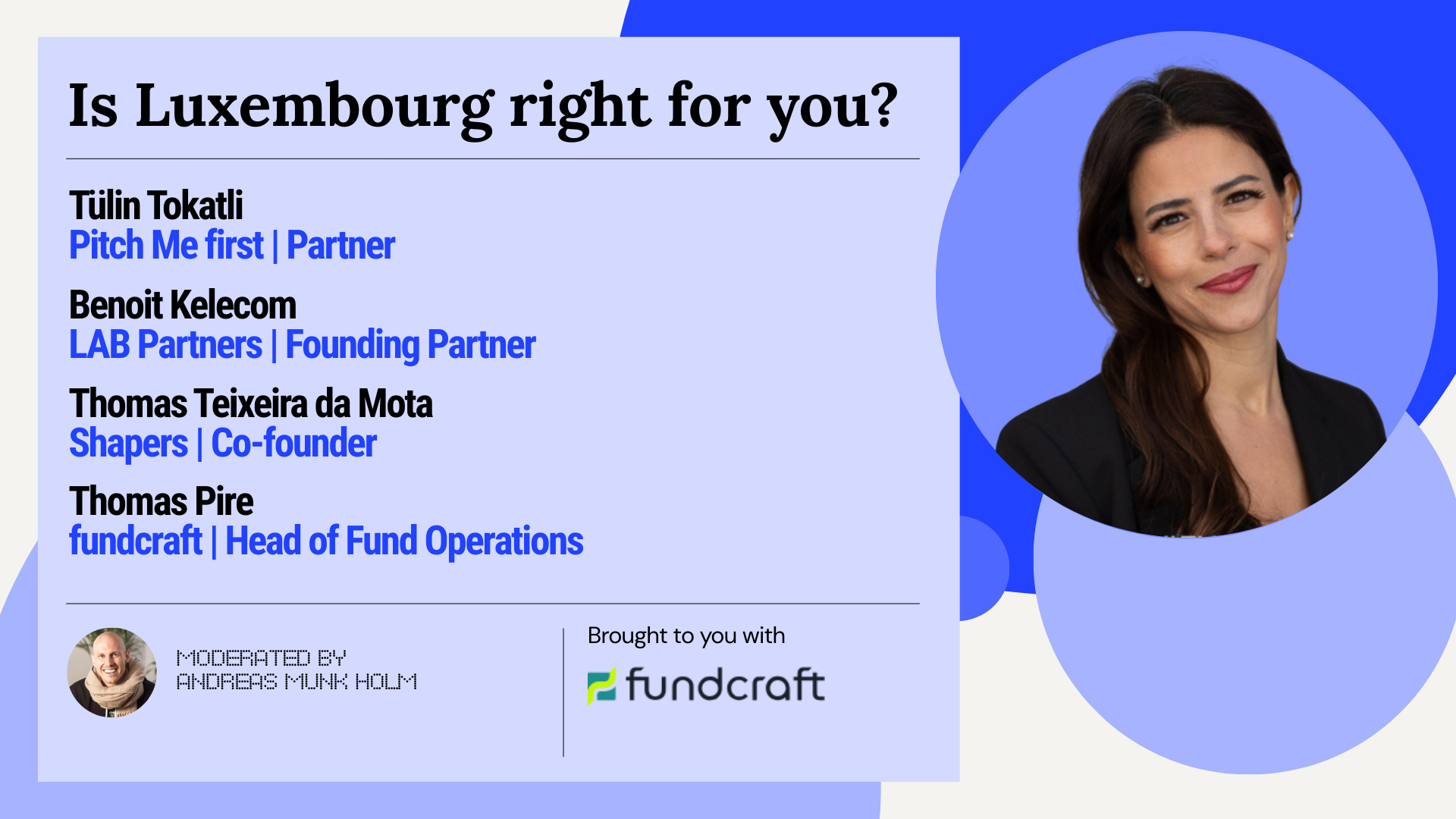
[Webinar] Is Luxembourg right for you? | 18 March, 12-1PM CET, Online
Brought to you in partnership with Fundcraft, join leading fund managers and operators for a candid discussion on whether Luxembourg is the right jurisdiction for your fund. Our expert panel will break down the practical realities—from structuring and regulation to operations and scaling—to help you understand when Luxembourg makes sense and when it doesn’t. Expect real-world insights, clear trade-offs, and actionable takeaways for emerging and established fund managers alike.
A small step toward better fund models (for all of us)
We’ve been digging deep into fund modelling through masterclasses, podcasts, and countless GP/LP conversations. One thing is clear: everyone’s wrestling with similar challenges, but almost nobody talks about them openly.
So we’re pulling together a shared snapshot for the whole community. Not an ask, just something we’re building together so we can all get a clearer picture of where the real friction points are in fund modelling today.
You can read about it here, but more importantly, please add your voice 👇.
We’ll gather the themes and share them with everyone. No fluff, just continuously striving to raise the bar and giving Europe’s venture ecosystem the signal it’s been missing.
Grateful to be building this with you all.

Private Off-Site for Corporate Venture Leaders | 11–14 May | Piedmont
We are hosting a private, invitation-only off-site for corporate venture leaders and senior executives in the Piedmont region of Italy.
Designed as a deliberate alternative to traditional conferences, the off-site brings together a small group of experienced leaders for thoughtful dialogue, peer exchange, and reflection. Set in Piemonte’s wine country, the experience combines guided vineyard walks, unhurried meals at family-run wineries, and intimate fireside conversations in a private residential setting that fosters trust and candour.
This is a rare opportunity to step back, connect with peers, and reflect on leadership, strategy, and long-term perspective.
Learn more and request to join below.