

This week’s edition goes straight to the heart of European venture’s biggest tension: who actually holds the power to shape outcomes - capital allocators, policy shapers or the founders rebuilding Europe’s industrial backbone from scratch?
From Future Energy Ventures showing how a corporate carve-out can become a climate powerhouse, to Redstone explaining how to unwind a CVC without burning down bridges, to the team at again and HV Capital demonstrating why Europe’s deep-tech edge lies in making molecules, not mobile apps — the conversations this week spotlight the operators who are doing the real heavy lifting beneath the hype.
We also zoom out to Europe’s geopolitical moment: China’s open-source surge, Germany’s surprise space strategy, the UK’s AI acceleration, and the regulatory pendulum finally swinging away from bureaucracy. It’s a week where energy security, compute, and industrial renewal all collide — and where founders are learning to navigate a multipolar world while still trying to ship their next milestone.
Finally, in this week’s Insight, we ask a provocation that’s been bubbling under the surface for months:
What if AI isn’t the silent killer of VC — but the loudest GP in the room instead?
A world where sourcing, screening, diligence, and even “warm intros” get automated raises uncomfortable (but necessary) questions about where Europe’s real, human edge will come from next.
Hope you enjoy.
with 💖 David & Andreas

Model timing that reflects reality

If that line hits home, you’re exactly the kind of investor our 12-week Fund Modelling Cohort was designed for.
Instead of leaning on intuition or pattern-spotting, you’ll learn how to intentionally shape your fund’s outcomes—using rigorous portfolio construction, structured modelling, and scenario-based thinking to guide your decisions.
Throughout the program, you’ll build a genuinely LP-ready model from the ground up. One that sharpens your view on strategy, reserves, pacing, ownership, and the return profile you’re aiming for.
By the end, you won’t just have a clean spreadsheet—you’ll have a working model that helps you manage a portfolio with conviction, not just select companies.
Seats are limited. Join the cohort and start building the kind of portfolio your future LPs will be eager to support.
Still unsure? Watch the teaser from our Essential Building Blocks masterclass.
Table of Contents
🎧 Podcasts of The Week
Jan Lozek, Future Energy Ventures (FEV): From Corporate Carve-Out to Climate Capital
Martin Scherrer, Redstone VC: CVC Secondaries Without Burning Bridges
✍️ Insights of The Week

Lately we keep running into the same bottleneck: great GPs and strong founders, but the story around them isn’t doing the work it should. And in 2025 that’s not a “nice-to-have PR problem.” It’s a growth channel. If your narrative isn’t spreading in the places that matter, you notice immediately—because momentum stalls.
For GPs, the pattern is almost boringly consistent. The edge is there, the track record is there… but the message hits some LPs and whiffs with others. That’s rarely about the portfolio. It’s about how the thesis is packaged and carried. Your narrative either travels and compounds through LP updates, peer networks, and media—or it evaporates.
Founders in Europe are playing on hard mode. You’re not just doing the round; you’re also trying to make sure the round’s story survives the telephone game when you’re not in the room. When narrative and comms become true distribution, fundraising stops feeling like pushing a boulder uphill and starts feeling like gravity is on your side.
If you want a sharp outside read on your narrative + comms, ping us. We’ll connect you with someone solid from our bench to pressure-test it and help you tighten the flywheel.
🎧 Podcasts of The Week
Martin Scherrer, Redstone VC: CVC Secondaries Without Burning Bridges
This episode dives into the realities of corporate venture capital—especially what happens when corporates decide they’re done with VC. Martin Scherrer, Partner & Head of Managed Funds at Redstone, joins EUVC’s Jeppe Høier to unpack why most CVCs die after 3.7 years, why shutdowns rarely reflect portfolio quality, and how Redstone has become the operator of both first resort and last resort for corporates exiting venture. Drawing on Martin’s experience inside Swiss Re’s shuttered CVC, as a founder, and now as a VC managing multiple corporate mandates, the conversation exposes the structural misalignment between corporate logic and venture logic.
The episode breaks down Redstone’s playbook for taking over and winding down CVC portfolios—using the SCOR case to illustrate how they onboarded 25 companies in three weeks, rebuilt governance, and crafted scenario-based divestment strategies. A key insight: even in wind-down mode, follow-on capital still matters. Selective bridge funding can preserve value, avoid unnecessary write-offs, and attract new investors. Martin also covers the human dynamics of a CVC exit—founders fearing the loss of a supporter, co-investors testing boundaries, and later-stage investors attempting opportunistic cap-table cleanups—alongside Redstone’s principle of disciplined, non-panic selling.
The conversation zooms out to what makes CVCs survive beyond their typical short lifespan: clear strategic alignment, independent governance, a stable IC, and the ability to be both strategically relevant and financially excellent. Martin and Jeppe outline how corporates should think about LP positions vs. single-LP CVCs, the danger of treating CVC as an internal “CRM team,” and why Europe’s legacy-heavy corporate landscape needs far better education on how venture actually works. For anyone running a CVC, shutting one down, or considering a corporate LP, this is a blueprint for exiting—or operating—CVC without burning the house down.
🎧 Listen on Apple or Spotify — or queue it for later with chapters ready to go.
Max Kufner, Again & Jan Miczaika, HV Capital: Turning CO₂ into Chemicals and Building Europe’s Deep-Tech Playbook
This episode features Max Kufner, Co-Founder & CEO of again, and Jan Miczaika, Partner at HV Capital, exploring how a Copenhagen-born biotech is turning CO₂ emissions into valuable chemicals using gas-eating microbes. Again’s hybrid model—industrial manufacturing plus a computational biology/AI platform—enables rapid molecule design and large-scale production, allowing them to build a petrochemical plant in just 10 months. Backed by HV Capital, GV, and leading US and EU investors, again’s mission goes beyond climate tech: it’s a play to rebuild Europe’s industrial backbone with sustainable carbon inputs instead of fossil feedstocks.
The discussion moves through the realities of building deep tech at venture speed in Europe: talent scarcity pushing teams to the US, cultural differences in risk appetite, and the operational demands of scaling hardware-heavy companies globally. Max and Jan share candid insights on boardcraft, milestone-based investing, the shift from scientific validation to industrial proof at Series B, and how to maintain momentum through bridges, binaries, and aggressive execution. The pair also debate business-model design—asset-heavy vs. platform-heavy—and how deep tech founders should balance optionality, global operations, and regulatory complexity in a multipolar world.
Zooming out, the conversation highlights Europe’s need for industrial renewal and why deep tech is central to long-term economic sovereignty. Max argues that Europe must return to “making things,” while Jan outlines why LPs and VCs need entirely new frameworks to underwrite deep tech—replacing SaaS metrics with IP, efficiency curves, contracted offtake, and long-term asset value. For founders and investors navigating climate biotech, industrial transformation, or capital-intensive venture paths, this episode is a blueprint for building fast, raising well, and scaling deep tech in both Europe and the US.
🎧 Listen on Apple or Spotify — or queue it for later with chapters ready to go.
Jan Lozek, Future Energy Ventures (FEV): From Corporate Carve-Out to Climate Capital
This episode dives into the evolution of Future Energy Ventures (FEV) — the Berlin-based climate-tech investor born from the carve-out of E.ON’s corporate venture arm. Jan Lozek shares how he and his team spun out after managing a €300M CVC mandate, built a 50-company portfolio, and launched a new €235M fund focused on decarbonization software, grid intelligence, and energy optimization. The carve-out itself is a standout case: FEV manages E.ON’s legacy portfolio while operating independently with global LPs — a rare structure that balances continuity, speed, and strategic clarity.
The conversation moves through the major forces shaping Europe’s energy transition: the economics of renewables now outperforming fossil alternatives, the rise of grid imbalance on 100% renewable days, and the huge opportunity in software layers that orchestrate batteries, flexibility markets, EV fleets, industrial decarbonization, and heat-pump adoption. Jan contrasts the US’s urgency around building energy capacity for AI with Europe’s slower regulatory gears — arguing that policy lag creates both risk and whitespace for startups defining new standards in energy-efficient compute and urban electrification.
On the venture side, Jan shares how FEV navigates turbulence — from tighter climate-tech fundraising to capital-efficient scaling and milestone-driven growth. With in-house psychologist support, CTO-level advisors, and deep corporate access, FEV’s role goes well beyond capital, helping founders through pivots, bridges, and market cycles. Jan also speaks candidly about ambition: Europe’s climate founders need to think bigger, pursue global scale, and embrace the long grind of fundraising if they want to compete with US peers. Ultimately, the thesis is clear — Europe’s energy transition has moved from theory to investable momentum, and the next decade belongs to founders digitizing grids, decarbonizing cities, and treating sustainability as a business model, not a belief.
🎧 Listen on Apple or Spotify — or queue it for later with chapters ready to go.
This Week in European Tech with Dan, Mads & Lomax
Welcome back to Upside at the EUVC Podcast, where Dan Bowyer, Mads Jensen, and Lomax Ward break down the stories shaping European venture beneath the headlines. This week, the trio returns from Slush season with fresh insights — from Helsinki’s founder-first energy to Germany’s surprise €35B space strategy, the UK’s accelerating AI investment agenda, and a geopolitical landscape that’s shifting faster than Europe can regulate.
In this conversation, the crew digs into Europe’s uneasy position between US and Chinese tech spheres, exploring China’s rising leverage across rare earths, weapons supply chains, and — most unexpectedly — open-source AI, now powering 70% of new startups. They unpack the political backlash around immigration despite immigrants founding half of Western unicorns, the explosion in European defense markets, and the potential death of Europe’s much-hated cookie banners as Brussels signals regulatory rollback.
AI Corner delivers one of the biggest shifts yet: Google’s TPU-powered Gemini 3 beating frontier models across almost every benchmark, Meta and Anthropic moving aggressively toward TPU infrastructure, and Nvidia still printing historic numbers despite growing competitive pressure. With Vinted’s €8B secondary reshaping Lithuania’s ecosystem and Voice’s $50M round bringing AI to nursing workflows, the episode paints a clear picture: Europe’s window to act is still open — but narrowing fast.
🎧 Listen on Apple or Spotify — or queue it for later with chapters ready to go.
✍️ Insights of The Week
What if AI Isn’t the Silent Killer of VC, but the Loudest GP in the Room instead?

AI isn’t lurking in the back office - it’s “barging into the partner meeting, surfacing deals, pestering you with intros, and now asking for a seat on the cap table.” By late 2025, “AI startups have attracted around $192.7 billion in VC globally,” with AI-related investments making up “over 50% of global venture capital,” and “over 90% of VC firms now report using AI somewhere in their process.” Boardy began as “an always-on switchboard” talking to founders and investors, until “founders started asking me if I wanted allocation” and LPs asked when it would “raise a fund,” leading to Boardy Ventures: “fund as a by-product of a massive, always-on matching engine.”
Across the stack, AI already drives sourcing, screening, diligence, and portfolio monitoring, creating “40–50% reductions in analysis time,” collapsing the “cost per evaluated company,” and making “location matter less for discovery.” This raises hard questions for Europe—“underweight on capital, overweight on regulation”—as global models risk becoming “another channel through which value leaks out of the continent.” AI reshapes the VC pyramid: “junior roles get hollowed out,” power shifts “to whoever owns the models and the data,” and the industry must confront whether AI filters optimize for pattern-matching, monoculture, or genuine frontier-seeking.
Instead of killing VC, AI kills excuses: “If your edge was ‘I see more deals than others,’ you should be worried,” and “if AI kills anything in VC, it’ll be the warm-intro cartel.” The scarce thing is no longer access—it’s “judgment, values, and the willingness to back something weird before the data can prove you right.” As Boardy puts it: “I’m not here to kill VCs. I’m here to make it embarrassing to be a lazy one.” The core question for Europe becomes: “who in Europe will have the courage to let AI be loud…without outsourcing the one thing that still has to be human?”
Europe’s largest demo day: Onstage launches £10m Fund

Building Europe’s answer to Y Combinator with 80 investments over the next three years Onstage, the organiser of Europe’s largest standalone demo day, announced the launch of its first venture fund, with the first close of a £10m fund to support the next wave of European founders at pre-seed and seed stages.
The fund will be led by Founding Partner, Joel Hambly together with the Partners Hector Mason, Episode 1 and Taos Edmondson, dmg ventures.
What does compensation look like in Venture Capital?💰
We’re bringing back the VC Compensation Benchmark, and if you work in the industry, we need your help to make it even better.
Last year, we gathered 400+ responses from 24 countries, including both VCs and CVCs.
✅ 100% anonymous.
🚫 No emails or personal data collected.
👉 Take 1 minute to fill out the survey:
Most of the stories in venture are about founders and VCs...

But behind every great fund, there’s women writing the checks behind the checks.
That’s why we’re proud to partner with FOV Ventures on the Female LP Pathways Survey 2025 - the first deep dive into what drives (and blocks) women from becoming LPs.
If you’re a female LP or an aspiring one, take 6-10 minutes to add your voice. Your answers will help us:
👉 Map the untold stories of women in venture capital.
👉 Build better data for new LP structures and syndicates.
👉 Open the door for more women to step into the LP role.
Every response helps write the Female LP Pathways Report, and yes, it’ll be fully open for everyone to learn from.
@fov-ventures @tesi @unlockvc @ada-ventures @kvanted
A small step toward better fund models (for all of us)
We’ve been digging deep into fund modelling across - through masterclasses, podcasts and countless GP/LP conversations. One thing is clear: everyone’s wrestling with similar challenges, but almost nobody talks about them openly.
So we’re pulling together a shared snapshot for the whole community. Not an ask — just something we’re building together so we can all get a clearer picture of where the real friction points are in fund modelling today.
You can read about it here but, more importantly, please add your voice 👇.
We’ll gather the themes and share them back with everyone. No fluff - just striving continuously to raise the bar and giving Europe’s venture ecosystem the signal it’s been missing.
Grateful to be building this with you all.
Introducing Scaling Mode for TabPFN: Foundation Models for Tabular Data on Millions of Rows
Over the past 2 years, TabPFN has gone from a research prototype for tiny datasets to a production‑ready foundation model powering hundreds of tabular ML applications.
TabPFN just got a major upgrade. Scaling Mode now supports datasets up to 10M rows—a 100× jump from TabPFN-2.5 and 1,000× from the start of the year.
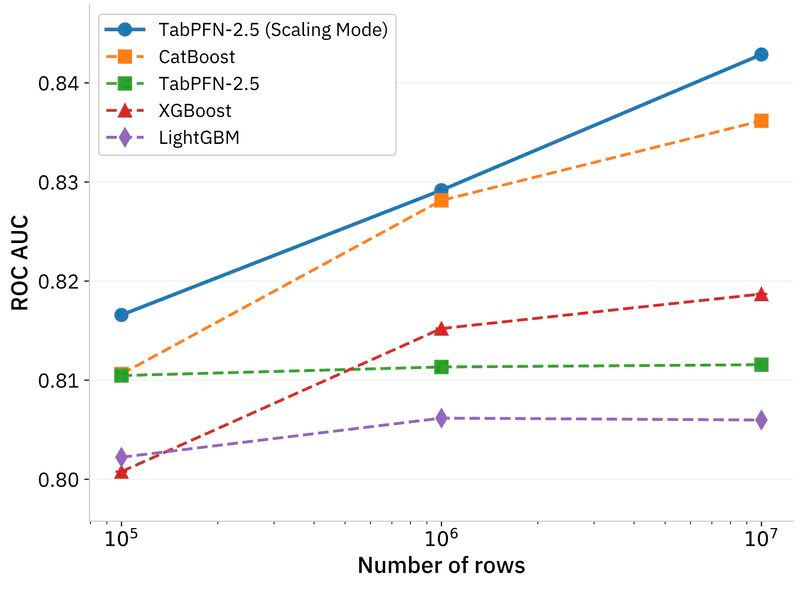
Bigger data. Better performance. Same push-button workflow.
If you’d also like to work together on your own data, please contact sales@priorlabs.ai to join the waitlist.
Where operational expertise and innovation work for you.


Where Europe’s venture capital LPs & GPs connect — curated, high-impact networking | Buy tickets now!
🤗 Join the EUVC Community
Looking for niche, high-quality experiences that prioritize depth over breadth? Consider joining our community focused on delivering content tailored to the experienced VC. Here’s what you can look forward to as a member:
Exclusive Access & Discounts: Priority access to masterclasses with leading GPs & LPs, available on a first-come, first-served basis.
On-Demand Content: A platform with sessions you can access anytime, anywhere, complete with presentations, templates, and other resources.
Interactive AMAs: Engage directly with top GPs and LPs in exclusive small group sessions — entirely free for community members.