

The Forces Behind the Flywheel
LPs, quant models, solopreneurs and sovereignty: this week’s conversations expose how Europe’s edge is being rebuilt.
This week’s newsletter zooms in on the real engines of power in European tech. The LPs, GPs, and decision systems that determine who gets to build, who gets to scale, and who gets left behind.
From Jack Leeney breaking down the AI supercycle and Europe’s liquidity deficit, to Rule 30 revealing what a fully systematic VC model could look like, to Leyla Holterud mapping Europe’s growth and secondary markets from a global vantage point. Every conversation this week exposes how capital concentration, data, and decision-making are shifting under our feet.
We also go deep with Mikael Johnsson on the widening gap between AI hype and real enterprise productivity and why valuation discipline, workflow embedding, and defensible data loops matter far more than demo-ready prototypes.
Finally, in this week’s Insight, we share the first directional findings from our fund modelling study; and they’re a bit of a gut punch. Most European GPs are still building funds on spreadsheet duct tape, scenario work is where models break fastest and LP expectations are running miles ahead of modelling reality. The result is a widening literacy and tooling gap that quietly drives fundraising friction, weak conviction and fragile reserves logic. If fund models determine how capital actually behaves, this is one part of the engine Europe can’t afford to keep pretending is fine.
Hope you enjoy.
With 💖 David & Andreas

“Alpha is rare.”
Instead of leaning on intuition or pattern-spotting, you’ll learn how to intentionally shape your fund’s outcomes using rigorous portfolio construction, structured modelling, and scenario-based thinking to guide your decisions.
Throughout the 12-week Fund Modelling Cohort, you’ll build a genuinely LP-ready model from the ground up. One that sharpens your view on strategy, reserves, pacing, ownership, and the return profile you’re aiming for.
By the end, you won’t just have a clean spreadsheet. You’ll have a working model that helps you manage a portfolio with conviction, not just select companies.
Seats are limited. Join the cohort and start building the kind of portfolio your future LPs will be eager to support.
Still unsure? Watch the teaser from our Essential Building Blocks masterclass.
Table of Contents
What Moved in European Tech This Week
Podcasts of The Week
Jack Leeney, 7GC: The AI Supercycle, IPO Windows & Europe’s Missing M&A Flywheel
Mikael Johnsson, Oxx: AI Hype, Real Productivity & How Not to Lose the Plot
Serving Europe’s Builders with Live Announcements
EUVC Startup Announcements Series featuring Donna and Prior Labs
Insights of The Week
What Moved in European Tech this Week
Spotted with help from our friend Sebastian Johnson, founder of Scaling Europe.
Black Forest Labs: The Freiburg-based team raised a $300m Series B led by Salesforce Ventures at a $3.25bn valuation, just ~15 months after launch.
Why it matters: another signal that Europe can mint global-scale AI leaders fast, and the Meta/Adobe/Microsoft integrations suggest real platform gravity, not just hype.
Brevo: The French CRM hit unicorn status via a partial exit as General Atlantic and Oakley Capital invested $500m and bought out Partech; now >$200m revenue and pushing hard into the US vs Salesforce/HubSpot.
Why it matters: a European SaaS player proving it can scale revenue and go head-to-head in the hardest market.
Lovable: A leaked deck shows the company targeting 65% gross margins, roughly doubling where they are today.
Why it matters: if they pull it off, it’s a major shift in unit economics that changes how investors underwrite the business (and how aggressive the growth plan can be).
ElevenLabs: CEO Mati Staniszewski landed on the US Forbes cover (first European in four years), with reported ~$100m profit over the last 12 months.
Why it matters: rare combo of cultural breakout + serious profitability, which strengthens Europe’s credibility in frontier AI commercialisation.

Distribution is becoming a core part of the venture playbook, and a strong communications strategy is key to helping you compound in the right rooms.
EUVC Communications combines Europe’s leading venture platform with a decade of specialist tech communications expertise. We help founders and funds shape their narrative, own their category and get in front of the people who matter: investors, customers, partners and talent.
To encourage more European founders and investors to communicate with impact, we are gifting one European team a complimentary communications strategy session led by one of our sharpest comms operators.
Apply now and we will select one team.
If you know a team this opportunity would benefit please feel free to forward this offer.
Podcasts of The Week
Jack Leeney, 7GC: The AI Supercycle, IPO Windows & Europe’s Missing M&A Flywheel
This episode features a conversation with Jack Leeney, co-founder of 7GC, the transatlantic growth fund backing AI leaders like Anthropic, Poolside, and Fluidstack. Drawing on a career that spans Morgan Stanley IPOs, Telefónica’s US venture arm, and now a dual-continental fund, Jack lays out why 7GC invests where liquidity lives, why this AI cycle is a compute cycle rather than a hype cycle, and how value will consolidate first in infrastructure and platforms before it trickles down to vertical applications. His stack hierarchy is clear: hardware and compute access → infrastructure software → platforms → vertical apps, with most early returns accruing to the bottom layers of the stack.
Jack maps today’s model landscape with unusual clarity - OpenAI owning consumer, Anthropic winning enterprise, Mistral aligning with European sovereignty, and Llama driving open-source velocity without a business model to match. He argues Europe’s talent is world-class, but the liquidity gap is existential: without deeper IPO markets, scaled M&A, and faster exits, Europe’s breakthroughs risk permanently flowing into US capital markets. That’s why Poolside, Fluidstack, and other European AI plays are structured for dual-market access: European teams, US-scale outcomes. He also calls the EU AI Act more noise than an existential threat, framing regulation as a moat for founders who can ship inside Europe’s policy framework.
The conversation closes on the mechanics of liquidity: the return of US IPO windows, the role of secondaries in growth-stage investing, and why any company valued over $1B is effectively constrained to either going public or landing one of the year’s top ten M&A deals. Jack’s diagnosis of Europe’s bottleneck is blunt - “the problem isn’t talent, it’s scaled M&A” - and his playbook for the continent is just as direct: treat regulation as differentiation, build for two markets, push corporates to acquire rather than partner, and use secondaries to recycle capital into the ecosystem. The next supercycle, he argues, will belong to those who solve Europe’s liquidity deficit, not those who simply build great tech.
🎧 Listen on Apple or Spotify - or queue it for later with chapters ready to go.
Damian Cristian & Guy Conway, Rule 30: From Data-Driven to Decision-Driven — Building the First Fully Systematic VC
This episode features Damian Cristian and Guy Conway, co-founders of Rule 30, the AI research lab building what they claim is the world’s first fully systematic venture strategy. They draw a sharp line between “data-driven” VC - hygiene tools that clean up CRMs and signals - and true quantitative VC, where models make and defend decisions based on learned patterns rather than partner vibes. With 15 years of labeled startup history baked into their training set, Rule 30 focuses not on picking unicorns but on predicting top-decile valuation delta, using signals like founder trajectory curves, graph evolution, and biology-inspired market topology to find repeatable outlier probabilities at pre-seed.
Damian and Guy challenge venture’s sacred cows: pre-seed isn’t an access problem but a triage problem; follow-ons often destroy expected value; and the “30–40 deals + reserves” middle strategy is mathematically the valley of death. Their portfolio construction philosophy targets 75–85 initial checks, no reserves, and large upfront sizing to reduce outcome volatility and engineer a ≥3× return profile with 97.5% confidence. They argue that algorithms can see far more pre-seed signal than humans can compute, and that technical founders increasingly trust the transparency of algorithmic ICs, where auto-generated memos and structured evaluation replace charisma-led decision-making.
The conversation also dismantles the “access myth” - claiming that 99% of pre-seed rounds are open to smart capital - and explains why Rule 30 rejects the SaaS model for selling their alpha. Instead, they view themselves as an AI research lab mining proprietary insights, potentially expanding into later-stage quant strategies across private markets. For LPs evaluating systematic managers, GPs rethinking reserves, or founders curious about how algorithms interpret team evolution, this episode lays out a candid blueprint for what decision-driven venture could look like - and why the future of pre-seed might belong to those who trust the math over the mythology.
🎧 Listen on Apple or Spotify - or queue it for later with chapters ready to go.
Leyla Holterud, Vintage Investment Partners: European Venture: Growth, Secondaries, and the Future of Vintage Investment Partners
This episode features Leyla Holterud, partner at Vintage Investment Partners and formerly a key figure in StepStone’s EMEA venture practice. Now helping deploy $4.3B across fund-of-funds, growth, and secondaries from Vintage’s new London hub, Leyla brings a panoramic view of European venture’s evolution. She reflects on a decade of change: Europe’s venture share rising to one-third of US volume, a more resilient post-2022 market than the US, and the quadrupling of unicorns driven by stronger founder pipelines and more committed capital. Her core thesis is simple: Europe is now a globally relevant venture ecosystem, not a regional one.
Leyla offers a nuanced take on the ongoing “barbell debate” around fund sizes. What matters isn’t AUM - it’s the individuals, their strategy, and their ability to access top founders. She outlines what makes platform funds powerful (domain specialists, operator DNA, and enterprise-scale support) and why moving from seed to growth requires dedicated teams rather than generic scaling. Her framework for underwriting managers mirrors evaluating founders: track record, character, ambition and an “unfair advantage” in picking and winning top companies. Vintage backs both emerging GPs and large platforms, positioning itself to identify Europe’s next generation of top-tier managers.
The discussion also digs into sector momentum - AI (especially infra and applied layers), FinTech and energy - alongside Europe’s regulatory paradox: complex but often a competitive moat. Leyla outlines how Vintage’s combination of fund-of-funds, growth, and secondaries creates a uniquely valuable platform for LPs, GPs and founders, particularly in a world where companies stay private longer. Looking ahead, she envisions Vintage as a trusted long-term partner helping expand Europe’s venture capacity, unlock more DPI and support both emerging managers and established franchises. The London presence, she says, is only the beginning.
🎧 Listen on Apple or Spotify - or queue it for later with chapters ready to go.
Mikael Johnsson, Oxx: AI Hype, Real Productivity & How Not to Lose the Plot
Andreas sits down with Mikael Johnsson, General Partner at Oxx, to unpack the gap between AI hype and real enterprise adoption. Mikael warns that valuation discipline is slipping as capital chases pilots rather than production deployments. With only 8% of companies running genAI in production and 92% still experimenting, he argues much of today’s “traction” reflects curiosity, not embedded workflows or durable revenue. The circular funding loops between hyperscalers and model companies only intensify the disconnect between expectations and actual business value.
The conversation dives into how to distinguish genuine ROI from noise: usage spreading across departments, products embedding into core workflows and retention patterns appearing at “warp speed.” Mikael is pragmatic about building on public LLMs - fine, as long as founders avoid lock-in and anchor defensibility in orchestrating business processes and owning transactional data. True moats emerge not from speed alone but from becoming the system of interaction for multi-stakeholder workflows. He’s blunt about the coming reckoning: 2024–2026 vintages will produce a few generational winners - and a long tail of overfunded companies backed at prices that never made sense.
Oxx’s approach is to “climb another hill,” avoiding overheated rounds and backing domain-native founders who understand the workflows they’re rebuilding. Team composition is shifting - leaner engineering teams, a critical lead architect and GTM that still requires enterprise muscle. Mikael believes we are in an AI bubble on timing, not on technology: the long-term impact is undeniable, but the market is wildly overestimating how quickly AI becomes recurring enterprise spend. The winners will be founders who embed into real workflows, build defensible data loops and stay disciplined while the rest of the market rides the peak of inflated expectations.
🎧 Listen on Apple or Spotify - or queue it for later with chapters ready to go.
This Week in European Tech with Dan, Mads & Lomax
This episode brings together Dan Bowyer, Mads Jensen, Lomax Ward and special guest Robin Haak to dissect the political, economic, and regulatory pressures reshaping European tech. Robin - founder of Robin Capital, early SmartRecruiters operator, and angel in 100+ companies - brings an insider’s view on Germany’s economy, Europe’s compliance burden, and how policy is increasingly determining winners. The crew breaks down everything from the EU’s push to restrict social media for minors to surveillance-leaning drafts that threatened private messaging, the UK’s unexpectedly startup-friendly budget and Lovable.ai’s VAT fiasco as a case study in Europe’s regulatory fragmentation.
The conversation shifts into deeper structural issues across Europe, with a focus on Germany’s economic stagnation: energy shortages, collapsing education outcomes, overloaded municipalities, rising welfare pressure, and political paralysis. Robin argues that Germany’s nuclear shutdowns created an energy squeeze at the worst possible time for AI. France and the Nordics, with their surplus clean power, now stand to become Europe’s compute hubs. N26’s long battle with BaFin illustrates how regulation doesn’t just shape compliance - it shapes outcomes and valuations. Across cities like Munich, Warsaw, Prague and Paris, deep-tech ecosystems are booming, yet founders still fight systemic friction: notaries, ESOP limitations, GmbH constraints, slow M&A and patchwork rules.
The group also dives into the rise of solo GPs, the American operator-fund model finally taking root in Europe and why founders increasingly prefer fast-moving, experience-driven angel-GPs over traditional firms. In AI Corner, the team examines the compute arms race - OpenAI’s trillion-dollar energy appetite, Google’s TPU comeback, Anthropic’s momentum and nations treating compute like strategic oil. Their shared conclusion: Europe is entering a decade defined by energy scarcity, regulatory realignment and an AI acceleration curve steeper than most policymakers grasp. The founders who win will be those who can execute through complexity, not around it.
🎧 Listen on Apple or Spotify - or queue it for later with chapters ready to go.
Serving Europe’s Builders with Live Announcements
This week, we tried something new at EUVC.
Over the past few weeks, we’ve been reading (and agreeing with) Eleanor Warnock’s excellent Sifted piece — “The funding round announcement is dead.” She argues founders deserve better than templated PR blasts nobody reads. What resonates much more?
Authentic, founder-led stories that explain why a round matters and what it unlocks.
Short, fast, honest conversations with founders at the exact moment something big drops - recorded with zero fluff, zero edits and published immediately to help them reach the European ecosystem directly.
And this week, we have two perfect examples to kick off the series.
Donna Raises $4.8M to Bring AI Agents to Field Sales
We sat down with Nicolas Christiaen, co-founder & CEO of Donna, right as they announced their $4.8M seed round.
This is one of the most underserved categories in tech: field sales - the millions of reps who spend their day in cars, shops, medical practices, pharmacies and factories, not behind screens.
Donna is building a voice-native, proactive AI agent that:
briefs you before meetings
coaches you on the road
calls you after a meeting
captures all your notes
updates the CRM
drafts follow-up emails
and keeps you on top of your pipeline
All in 40+ languages.
All completely hands-free.
All powered by multimodal AI.
The founders are second-time operators with deep experience in field automation and the problem is so real you can feel it in the recording.
Prior Labs Hits a World First in Tabular AI
We also went live with Sauraj Gambhir, co-founder of Prior Labs, literally at the moment they announced that Tap-PFN can now handle datasets of 10 million rows - the first time a tabular foundation model has crossed that threshold.
To put it plainly:
If your company runs thousands of ML models on structured data (banks, insurers, telecoms, healthcare, marketplaces), this is one of the biggest step-changes you’ve seen in a decade.
Eight months ago, Prior Labs could handle 10k rows.
Four weeks ago: 100k.
Now: 10 million, with more on the way.
This is the beginning of the LLM moment for tabular data, and Sauraj breaks it down in clear terms.
Founders, big news coming up? We’ll amplify it.
We are strong believers in the power of founder-led communication and are committed to amplifying the stories of Europe’s most promising companies.
We’re testing a new format to better serve the European venture ecosystem. Not with PR noise, but with actual founder stories that matter.
If you (or someone in your portfolio) have a meaningful announcement coming up: a raise, a milestone, a major launch, send us a line at 📩 hello@eu.vc.
This is not PR.
This is community.
This is builders talking to builders.
Insights of The Week
The State of Fund Modelling in VC (Preliminary Findings)
If you’ve been following along, you’ll know we’ve been quietly collecting data on one of the most under-discussed but absolutely mission-critical parts of venture capital: fund modelling.
And after processing the first wave of responses, we can confidently say two things:
VCs are building funds on shockingly shaky modelling foundations.
LPs assume our models are far better than they actually are.
What does compensation look like in Venture Capital?💰
We’re bringing back the VC Compensation Benchmark, and if you work in the industry, we need your help to make it even better.
Last year, we gathered 400+ responses from 24 countries, including both VCs and CVCs.
100% anonymous.
No emails or personal data collected.
Take 1 minute to fill out the survey.
Most of the stories in venture are about founders and VCs...

But behind every great fund, there’s women writing the checks behind the checks.
That’s why we’re proud to partner with FOV Ventures on the Female LP Pathways Survey 2025 - the first deep dive into what drives (and blocks) women from becoming LPs.
If you’re a female LP or an aspiring one, take 6-10 minutes to add your voice. Your answers will help us:
Map the untold stories of women in venture capital.
Build better data for new LP structures and syndicates.
Open the door for more women to step into the LP role.
Every response helps write the Female LP Pathways Report, and yes, it’ll be fully open for everyone to learn from.
The State of Gen Z: Power, Paradox & the Next Decade of Change
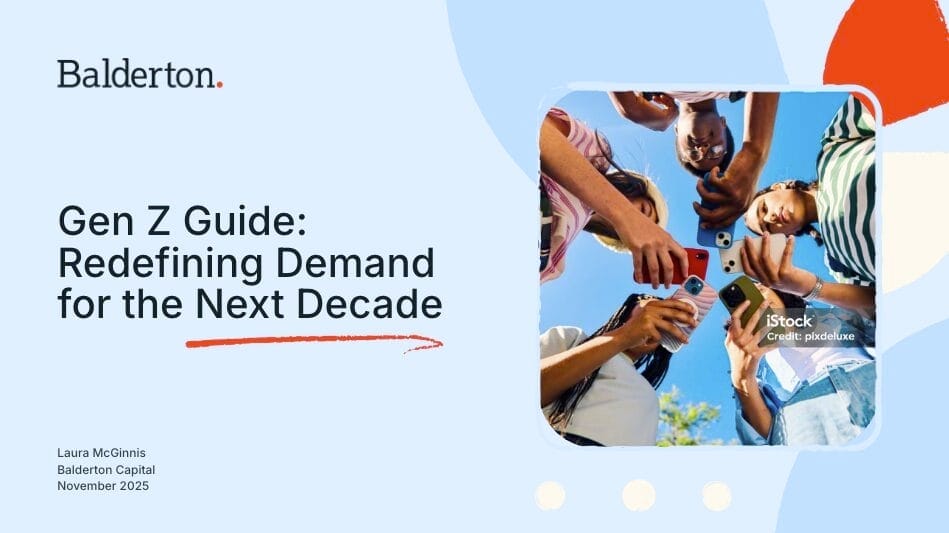
With 2B people globally and $12T in projected spending power by 2035, Gen Z isn’t just influencing markets, they’re defining them. Born online and raised through uncertainty, they blend creativity, activism, and digital fluency in ways that reshape how identity, trust, and value are formed. What often looks like contradiction is actually adaptation: a generation turning crisis into creativity and technology into everyday infrastructure.
Over the past year, Balderton Capital’s Laura McGinnis worked with Gen Z communities, Edelman’s Gen Z Lab, BCG, and a global network of founders and VCs to understand how this generation thinks, builds, and buys. The result is a new report that explores their emerging identity and what it means for the next wave of products, companies, and culture.
If you’re building for this audience or investing in the systems they’ll reshape, this deep dive outlines the five forces shaping their world and the opportunities emerging from it.
Where operational expertise and innovation work for you.


🤗 Join the EUVC Community
Looking for niche, high-quality experiences that prioritize depth over breadth? Consider joining our community focused on delivering content tailored to the experienced VC. Here’s what you can look forward to as a member:
Exclusive Access & Discounts: Priority access to masterclasses with leading GPs & LPs, available on a first-come, first-served basis.
On-Demand Content: A platform with sessions you can access anytime, anywhere, complete with presentations, templates, and other resources.
Interactive AMAs: Engage directly with top GPs and LPs in exclusive small group sessions — entirely free for community members.