

The Systems Behind the Next Tech Cycle
AI in music, deep tech demand, industrial decarbonisation, and why narrative may become Europe’s next competitive edge.
Hi friends 👋
This week explores a common thread across venture, technology, and industry: what happens when the underlying assumptions start to shift.
We kick things off in the music industry, where AI is beginning to reshape both the creative process and the balance of control. Together with Ash Pournouri (producer, entrepreneur, former manager of Avicii), Sundar Arvind (CEO & Co-Founder of Mozart AI), and Daniel Waterhouse (General Partner at Balderton Capital) we discuss rights, training data, and monetisation, and the question at the centre of it all: who owns the rails?
Then we go one level deeper into Europe’s most persistent bottleneck: deep tech. Martin Schilling, former operator, investor, and founder of Deep Tech Momentum, argues that the problem isn’t funding but commercialisation and demand. If corporates and procurement don’t change behaviour, Europe will keep exporting its breakthroughs.
We also zoom in on industrial decarbonisation with Jo Slota-Newson and Marc Sabas, co-founders of Almanac Ventures to discuss a thesis on why the next decade of climate outcomes won’t come from apps, but from heat, materials, chemistry, and systems-level deep tech.
And finally, in a new piece co-authored with Cathy White, co-founder of CEW Communications, we argue that European tech’s next advantage may not be technical but narrative. As media fragments and AI reshapes discoverability, the companies that win will be those with the clearest, most consistent stories. They will treat communications not as PR output, but as infrastructure that builds trust across investors, customers and algorithms.
Hope you enjoy,
with 💖
David & Andreas

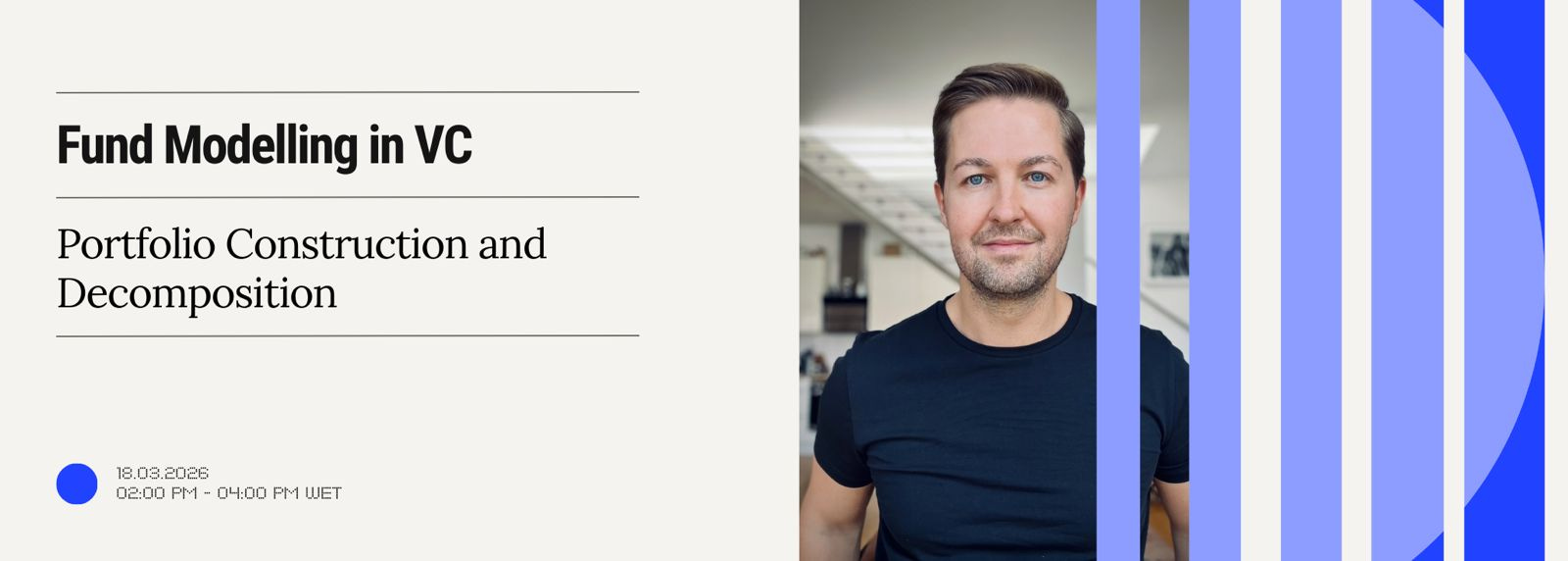
Virtual | Wednesday, March 18 | 02:00 PM - 04:00 PM GMT
If you’re building or managing a venture fund, your returns are shaped long before the exits happen. In this advanced 2-hour online masterclass, you’ll sharpen your ability to design, stress-test, and optimise your portfolio through better construction and decomposition.
You’ll learn how to structure entry and follow-on strategies, track capital deployment over time, simulate write-offs and exits, and model key performance metrics like TVPI, DPI, RVPI, and NAV with greater precision. We’ll focus on practical decision-making, real-world trade-offs, and dynamic asset valuation—so you can assess whether your strategy is truly set up to deliver.
Ideal for emerging fund managers, established VCs, family office and CVC professionals, and active HNIs who want to strengthen their fund modelling and make more informed portfolio decisions.
Table of Contents
Insights of the Week
Podcasts of The Week
Martin Schilling, Deep Tech Momentum: Why Europe’s Deep Tech Problem Isn’t Funding
Jo Slota-Newson & Marc Sabas, Almanac Ventures: Systemic Deep Tech for Industrial Decarbonisation
Events and Community Gatherings
Insights of the Week
European tech’s next advantage won’t be technical
In a new piece co-authored by our very own David Cruz e Silva and Cathy White, co-founder of CEW Communications, they argue that as capital tightens and expectations rise, the gap in European tech is no longer technical. It is narrative. Strong products often struggle while less ambitious ones break through. The difference is clarity.
Europe’s media landscape has fragmented. Traditional outlets have shrunk or consolidated, while influence has shifted to newsletters, podcasts, Substacks and individual voices. There is no longer a single headline that confers legitimacy. Attention is dispersed and trust must be earned repeatedly across formats.
At the same time, AI is reshaping discoverability. Companies are not only pitching journalists. They are also training algorithms. Consistent, credible and well attributed narratives increasingly determine who gets surfaced to investors, customers and machines.
The companies that win will not be the loudest. They will be the clearest. They will treat communications as infrastructure built through owned channels, founder voices and long term narrative discipline.
In a fragmented and AI mediated ecosystem, clarity compounds. For European tech, that may become a real competitive advantage.
Podcasts of the Week
Ash Pournouri (Belong), Sundar Arvind (Mozart AI) & Daniel Waterhouse (Balderton Capital): AI Music, Control and the Next Creative Era
In this special segment, we step inside the music industry at the exact moment AI begins reshaping how music is created, distributed, and defended.
Andreas is joined by Ash Pournouri — music entrepreneur, producer, former manager of Avicii, and founder of PRMD Music — alongside Sundar Arvind, CEO & Co-Founder of Mozart AI, and Daniel Waterhouse, General Partner at Balderton Capital, for a sharp, insider conversation about where the real fault lines sit: rights, training data, monetisation, creative identity, investor logic, and the deeper question of who controls the rails of music in the AI era.
This isn’t hype. It’s not “AI will replace artists.” It’s a grounded look at how one of the most rights-driven industries on earth reacts when technology lowers barriers again and how capital, law, and creators are each interpreting this moment differently.
Key takeaways from the episode:
▪️ Ash reframes himself as a tech thinker, not “just music” professional. Having lived through Napster, Spotify, and streaming’s rise, he sees AI less as shock and more as pattern repetition.
▪️ Daniel adds the investor lens. From a venture perspective, AI music isn’t just cultural disruption — it’s infrastructure shift. The question is which layer captures value: tooling, distribution, licensing, or rights aggregation.
▪️ Sundar represents the builder’s reality. AI music companies aren’t trying to replace artists — they’re trying to build tools. But tool adoption depends entirely on trust and framing.
▪️ The industry’s default mode is control. Music is structurally built around rights management, IP enforcement, monetisation guardrails, and legacy ownership structures. Disruption triggers protection reflexes.
▪️ Training data is the legal pressure point. Who owns it? Who licenses it? What counts as fair use? These questions will shape how fast the category can scale.
▪️ History repeats: Napster → Spotify → AI. Demand surfaces first. Legal structures follow. If users want something badly enough, it finds distribution.
▪️ Demand ultimately forces adaptation. If audiences engage with AI-assisted music, creators and rights holders will need to show up where attention flows.
▪️ Packaging determines adoption. AI framed as “replacement” creates fear. AI framed as “tool” unlocks cooperation. This is as much go-to-market strategy as it is ethics.
▪️ Lowering barriers has always expanded music. From studios → DAWs → Autotune → bedroom producers → streaming. Every wave was accused of dilution. Every wave expanded output.
▪️ Creativity ≠ prompt-only. The skill curve doesn’t disappear. There will be a meaningful gap between casual users and serious creators who understand craft and iteration.
▪️ The real fight is about rails. Distribution control, monetisation splits, licensing power, and data ownership — that’s where capital and industry collide.
▪️ We’re on the vertical part of the curve. Predicting five years out feels naive. Tooling evolves monthly. It feels like “ten years happen in one year.”
▪️ AI reduces friction, not ambition. When admin and overhead drop, creative energy increases. The tools don’t remove the human — they accelerate expression.
🎧 Listen on Apple Podcasts or Spotify, or queue it up with chapter markers ready to go.
Martin Schilling, Deep Tech Momentum: Why Europe’s Deep Tech Problem Isn’t Funding
Europe does not have a deep tech problem. It has a commercialisation problem.
In this episode, Andreas sits down with Martin Schilling — former N26 operator, investor, and founder of Deep Tech Momentum — to unpack why Europe excels at funding scientific breakthroughs but consistently struggles to industrialise them.
The last European companies to reach €100B+ market caps were SAP and ASML, founded 40–50 years ago. If Europe wants a new generation of deep tech champions, venture capital alone won’t get us there. Customers have to step in.
This is not a capital debate. It’s a demand debate.
Key takeaways from the episode:
▪️ Europe funds breakthroughs — others industrialise them.
Europe produces world-class research across quantum, robotics, biotech, advanced materials, space, and defence. But enterprise pull is weak. Startups scale slower, exits skew toward US acquirers, and capital recycles out of the continent.
▪️ The age gap explains more than we admit.
Top 10 European companies by market cap average ~87 years old. In the US, it’s ~30–35 years. Younger corporates collaborate and acquire more. Older ones accumulate procurement drag, risk aversion, and bureaucracy.
▪️ US corporates acquire ~2x more startups.
Silicon Valley giants acquire 10–20x more than European counterparts. Acquisition muscle shapes ecosystems. Europe’s is underdeveloped.
▪️ Corporates — not just VCs — must change behaviour.
Innovation labs and CVC units are not enough. If startup collaboration is not owned by the CEO, it becomes theatre.
▪️ The four corporate failures blocking deep tech:
– No CEO ownership
– Structural trust deficit between buyers and startups
– No fast POC budgets or empowered decision-makers
– Lack of P&L clarity on why the startup matters
If a solution doesn’t hit revenue, cost, or competitive advantage within 9–12 months, it rarely scales internally.
▪️ Trust is the real bottleneck.
Corporates fear startups will disappear mid-procurement. Founders fear endless pilots and no budget owner. Trust must be rebuilt structurally — not rhetorically.
▪️ Neo-primes are Europe’s missing layer.
Martin introduces the concept of “neo-primes”: modern system integrators that assemble deep tech into deployable products, act as customers and acquirers, and industrialise innovation at speed. Europe needs many more of them.
▪️ Buyers first — not investors first.
Deep Tech Momentum flips the typical conference model. Enterprise buyers show up first. Founders follow. Investors amplify. Markets function when demand leads.
▪️ Enterprise sales is a discipline, not luck.
Founders must track input KPIs — proposals sent, outreach conversion, pipeline coverage (3–4x minimum). In regulated sectors like defence, selling starts years before procurement opens.
▪️ CVCs can help — or hurt.
Strategic capital works when aligned with business units and procurement. Otherwise it becomes optionality without commitment.
▪️ The state’s role is demand, not grants.
The US Department of Defense purchased ~70% of early semiconductors. Procurement created industries. Europe doesn’t need more fragmented programs — it needs deliberate state purchasing power.
If Europe wants the next SAP or ASML, venture capital cannot do it alone.
Deep tech doesn’t scale on grants. It scales on customers willing to buy.
🎧 Listen on Apple or Spotify, with chapters ready to explore.
Jo Slota-Newson & Marc Sabas, Almanac Ventures: Systemic Deep Tech for Industrial Decarbonisation
Industrial systems generate ~75% of global emissions. Yet only ~25% of climate-focused VC capital flows into them.
Not because investors don’t care — but because these systems are hard. Interconnected. Capital-intensive. Technically dense. Slow to change. And deeply under-innovated. Almanac Ventures is built for exactly that complexity.
In this episode, Andreas sits down with Jo Slota-Newson and Marc Sabas, co-founders of Almanac Ventures — a new European pre-seed and seed deep tech fund focused on scientific breakthroughs applied to industrial systems.
This is a pitch episode — a chance for the EUVC LP & GP community to hear directly how Almanac thinks, where they invest, and why the next decade of industrial decarbonisation will be shaped by specialist deep tech funds with real scientific and commercial edge.
Key takeaways from the episode:
▪️ The industrial capital gap is structural.
Industry drives ~75% of emissions. Only ~25% of climate VC targets it. The mismatch exists because industrial systems are complex, interconnected, and difficult to underwrite without technical depth.
▪️ Deep tech works for venture — if you know where to look.
Not every scientific breakthrough is venture-backable. Almanac looks for credible technical pathways that can hit value-creative milestones within 2–5 years — especially drop-in solutions and capex-efficient deployment models.
▪️ Performance + cost + decarb must move together.
Industrial buyers don’t adopt tech for climate optics. Solutions must improve performance, lower cost, and deliver measurable decarbonisation simultaneously.
▪️ Scientific rigour meets commercial structuring.
Jo brings a nanoscience PhD, deep tech operating experience, and nearly a decade of investing. Marc brings finance, corporate venturing, and climate VC experience. Together: 45+ investments, €47M deployed, and a 2.3x MOIC track record.
▪️ Systems thinking is the real edge.
Industrial processes are not linear. Energy flows, supply chains, materials, and regulation are interconnected. Generalist VCs often underweight these dependencies. Almanac underwrites at the systems level.
▪️ They invest at the “first valley of death.”
Almanac typically writes the first institutional check at TRL 4–7, helping companies move from lab validation to first commercial deployment, often the hardest transition in deep tech.
▪️ Case study: Hot Green.
A UK company building industrial heat pumps operating at up to 200°C for food & beverage, chemicals, and light industry.
The breakthrough: a new compressor architecture — the most expensive component — unlocking high performance at lower cost.
Industrial heat is one of the biggest decarbonisation levers hiding in plain sight.
▪️ Case study: ReClinker.
A Cambridge spinout recycling cement inside electric arc furnace steelmaking.
They piggyback on existing furnace heat, eliminate the CO₂-intensive clinker chemistry step, and decarbonise both cement and steel in one system.
Deep tech × systems leverage × capex-light deployment.
▪️ Operator experience isn’t the only credential.
Jo argues that technical credibility matters, but so does diversity of perspective.
Marc highlights corporate experience as a hidden advantage: understanding how industrial buyers actually adopt innovation is often the unlock.
▪️ Industrial tech isn’t “too hard” for venture.
The myth persists because many projects require infrastructure-scale capital. But targeted scientific breakthroughs embedded inside existing systems can scale with venture-style returns if structured correctly.
▪️ The opportunity is structural, not cyclical.
Industrial systems still run on 20th-century infrastructure. Inefficiencies are large. Value pools are deep. The next decade of climate innovation will be shaped less by apps and more by materials, heat, chemistry, automation, and electrification.
🎧 Listen on Apple or Spotify, with chapters ready to explore.
This Week in European Tech with Dan, Mads and Lomax
In this episode of Upside, Dan Bowyer, Mads Jensen of SuperSeed and Lomax Ward of Outsized Ventures unpack a week that felt like several systems colliding at once.
A conflict around one of the world’s most critical energy chokepoints threatens supply chains and inflation. AI companies are discovering that governments may ultimately control how frontier models are used. Hyperscalers are committing hundreds of billions to infrastructure while venture investors quietly debate whether the cycle is overheating.
And in Europe, Germany’s chancellor says the quiet part out loud: the continent simply isn’t productive enough.
This isn’t just tech volatility. It’s energy, capital, defence, and AI power dynamics shifting at the same time.
Key takeaways from the episode:
▪️ Energy shocks ripple directly into venture markets.
Roughly a fifth of global oil supply moves through the Strait of Hormuz. Any disruption there feeds straight into inflation, interest rates and liquidity — the same macro chain that ultimately determines startup funding conditions.
▪️ Warfare innovation is starting to look like startup innovation.
Cheap attack drones are increasingly countered with equally cheap interceptor drones instead of multi-million-dollar missile systems. Rapid iteration, short supply chains and software-defined battlefields are reshaping defence technology.
▪️ Ukraine has effectively become a live defence R&D ecosystem.
Continuous battlefield experimentation is creating new technologies, supply chains and companies — and much of that capability will likely persist and export after the war.
▪️ Anthropic vs the Pentagon exposed a deeper question about AI power.
When the company refused certain defence uses of its models, Washington responded with threats to designate it a national security supply-chain risk. The broader issue: if frontier AI becomes strategic infrastructure, governments may not tolerate private control.
▪️ AI layoffs may say more about the pandemic than the technology.
Many companies expanding rapidly during the Covid boom are now correcting headcount. AI productivity gains may be real — but the narrative is often arriving before the structural changes.
▪️ The hyperscalers are making a historic infrastructure bet.
Roughly $650B is expected to be spent on AI infrastructure this year alone across data centres, chips and energy. It’s one of the largest coordinated capital deployments the tech industry has ever seen.
▪️ At the same time, investors are quietly advising founders to prepare for shocks.
Some venture firms are warning startups to extend runway and avoid aggressive scaling. The contradiction between massive infrastructure investment and cautious venture sentiment defines the current moment.
▪️ Europe’s productivity problem is becoming political reality.
With defence spending rising and geopolitical pressure increasing, leaders are openly acknowledging structural economic weaknesses — from fragmented markets to slow procurement and regulatory drag.
▪️ Defence procurement may be the real bottleneck for Europe’s startup opportunity.
Rising budgets alone won’t create a venture-backed defence ecosystem. The real signal will be large, repeatable contracts flowing to new suppliers rather than legacy contractors.
▪️ Europe is still capable of genuine moonshots.
Proxima Fusion’s plan to build the continent’s first commercial fusion plant shows the region can still pursue ambitious scientific and industrial bets — even if the payoff is decades away.
🎧 Listen on Apple Podcasts or Spotify
Events and Community Gatherings
Join The EUVC Summit 2026 | 22/04/2026, London

Europe’s builders take the stage.
The EUVC Summit returns with founders, operators, VCs, and LPs focused on one question: how Europe wins.
From what it really takes to build category-defining companies in Europe, to how capital, conviction, and long-term alignment must evolve to compete globally — this is a working room, not a trends conference.
[Webinar] Is Luxembourg right for you? | 18 March, 12-1PM CET, Online

Brought to you in partnership with Fundcraft, join leading fund managers and operators for a candid discussion on whether Luxembourg is the right jurisdiction for your fund. Our expert panel will break down the practical realities—from structuring and regulation to operations and scaling—to help you understand when Luxembourg makes sense and when it doesn’t. Expect real-world insights, clear trade-offs, and actionable takeaways for emerging and established fund managers alike.
Mont Blanc Retreat 2026 | 7 -10 May | Piedmont and Chamonix

Come spend a few days with us in the French and Italian Alps. In Piedmont and Chamonix, we’re hosting a small, carefully curated gathering with Paolo Pio (Exceptional Ventures) and Itxaso del Palacio (Notion Capital), bringing together a handful of thoughtful builders and investors for guided treks, long lunches, fireside conversations and time to recharge in the mountains. No panels and no pitches. Just good people, honest dialogue and space to reflect on the road ahead.
Private Off-Site for Corporate Venture Leaders | 11–14 May | Piedmont

Join our private, invitation-only off-site for corporate venture leaders and senior executives in the Piedmont region of Italy. Designed as a deliberate alternative to traditional conferences, the off-site brings together a small group of experienced leaders for thoughtful dialogue, peer exchange, and reflection.