Pension capital will not enter venture at scale on the strength of return data alone. Institutions need a model they can underwrite: predictable commitments, aligned economics and a clear approach to liquidity. The difficult decision is knowing which mechanics to adapt and which investment principles to protect.
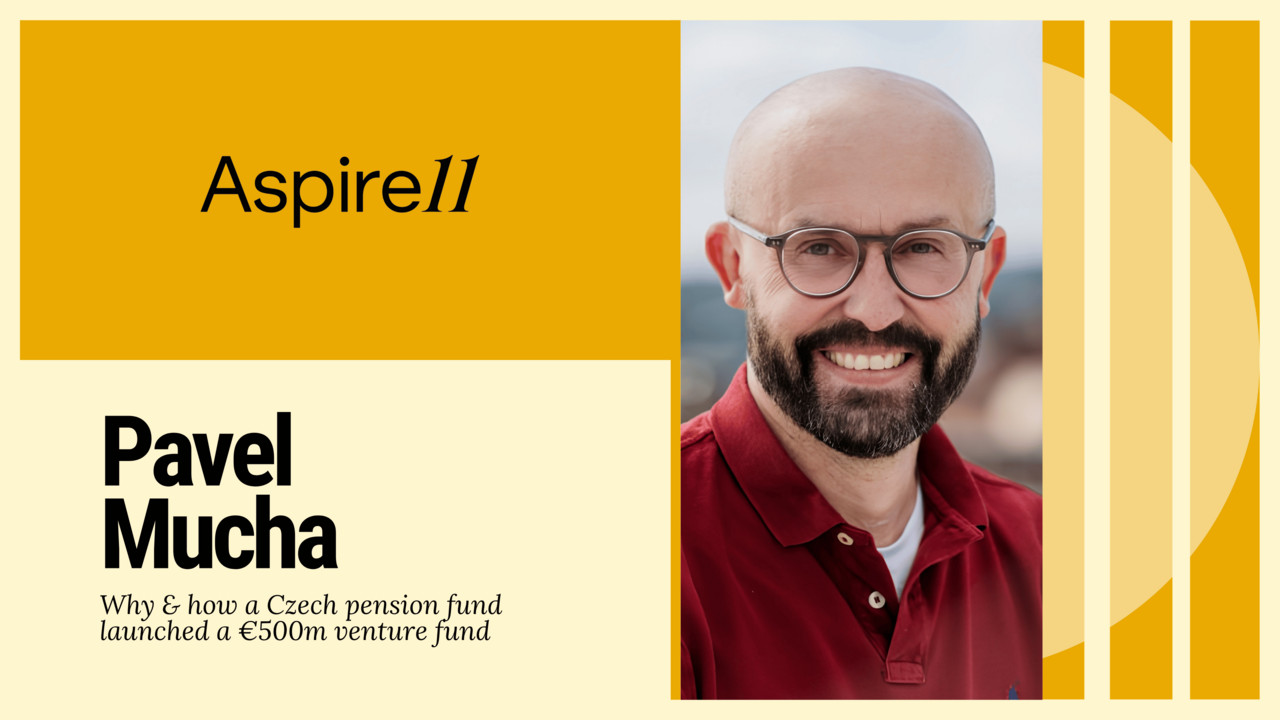
In this presentation at EUVC Summit 2026, Pavel Mucha, Founder of Aspire11, explains how the team secured a €500 million commitment from a Czech pension fund for venture and growth investing.
He outlines why Aspire11 reduced the initial ambition from €2 billion, how it designed the platform around the pension fund’s requirements and where it refused to compromise.
€500m was the first proof point
The pension fund initially considered committing €2 billion. Aspire11 proposed starting with €500 million and treating the deployment as a showcase that could unlock a larger allocation if the model performed as intended.
“We should first walk before we run.”
That smaller starting point did not mean lowering the investment ambition. It created a defined period in which both parties could test the operating model, economics and relationship before committing more capital.
The pension fund also wanted to attract younger savers. Pavel observed that people in their twenties and thirties already followed technology companies and developments in AI, but rarely had an opportunity to participate in their growth through their pension savings.
Venture exposure could therefore support both investment returns and the fund’s ability to make long-term saving more relevant to a younger generation.
Adapt the model, not the return engine
Aspire11 adjusted several elements of the platform to make the commitment easier for the pension fund to underwrite.
The team absorbed the initial costs during its first 12 months. It also removed an additional management-fee layer, taking performance-based economics instead. This aligned Aspire11 with the underlying GPs and reduced the pension fund’s concern about stacked fees.
“If you guys don’t deliver, we’re at zero with you.”
Aspire11 also divided commitments into shorter vintage windows. Pension funds must forecast annual inflows, outflows and asset-liability requirements, making a single long, open-ended commitment difficult to manage. Smaller windows gave the institution clearer visibility while Aspire11 managed the longer investment horizon.
The platform combined fund investments with later-stage direct investments. According to Pavel, putting these exposures together can help smooth the J-curve while creating opportunities to hold compounding companies for longer.
Three principles remained non-negotiable
Aspire11 drew inspiration from the Canadian Maple Eight pension model, particularly its evolution from passive capital pools into active investors. Three lessons shaped its approach.
First, the platform rejected home bias. Restricting investments to Czech companies would narrow the opportunity set and could weaken returns. Aspire11 needed the freedom to back the strongest GPs and companies beyond national borders.
Second, the pension fund had to accept long holding periods. Some private assets may be worth holding for more than ten years, even though Aspire11 does not interpret illiquidity as a case for an evergreen structure.
Third, the portfolio would remain concentrated.
“We’re not trying to index the market. We actually will build very concentrated portfolios.”
These principles protect the strategy’s ability to generate returns. Fees, commitment windows and initial costs could be redesigned around the institution. Geographic freedom, investment duration and concentration could not be compromised without changing the investment proposition itself.
A four-question test for pension-backed venture
Asset owners and venture managers can pressure-test a proposed model with four questions:
What outcome does the pension fund need? Define the return objective alongside strategic goals such as attracting younger savers.
Which sources of friction can be redesigned? Examine fees, setup costs, commitment windows and reporting requirements.
Which principles protect returns? Be explicit about geographic scope, concentration and holding periods before accepting capital.
Can the institution manage the cash flows? Show how vintages, fund commitments and direct investments affect deployment and the J-curve.
The practical implication is clear: venture managers seeking pension capital should arrive with an institutional operating model, not only a performance argument. They must show where they can accommodate the asset owner and where compromise would damage the strategy.
Listen on Spotify to hear Pavel explain the structure behind the €500 million commitment, then use the four-question test to assess whether your venture model is genuinely ready for pension capital.