When AI is changing the work, past experience alone cannot tell founders whether a senior hire will adapt with it.
Companies increasingly want leaders who can experiment with AI and understand how it applies within their function. Yet deep functional expertise remains essential where mistakes carry serious consequences.
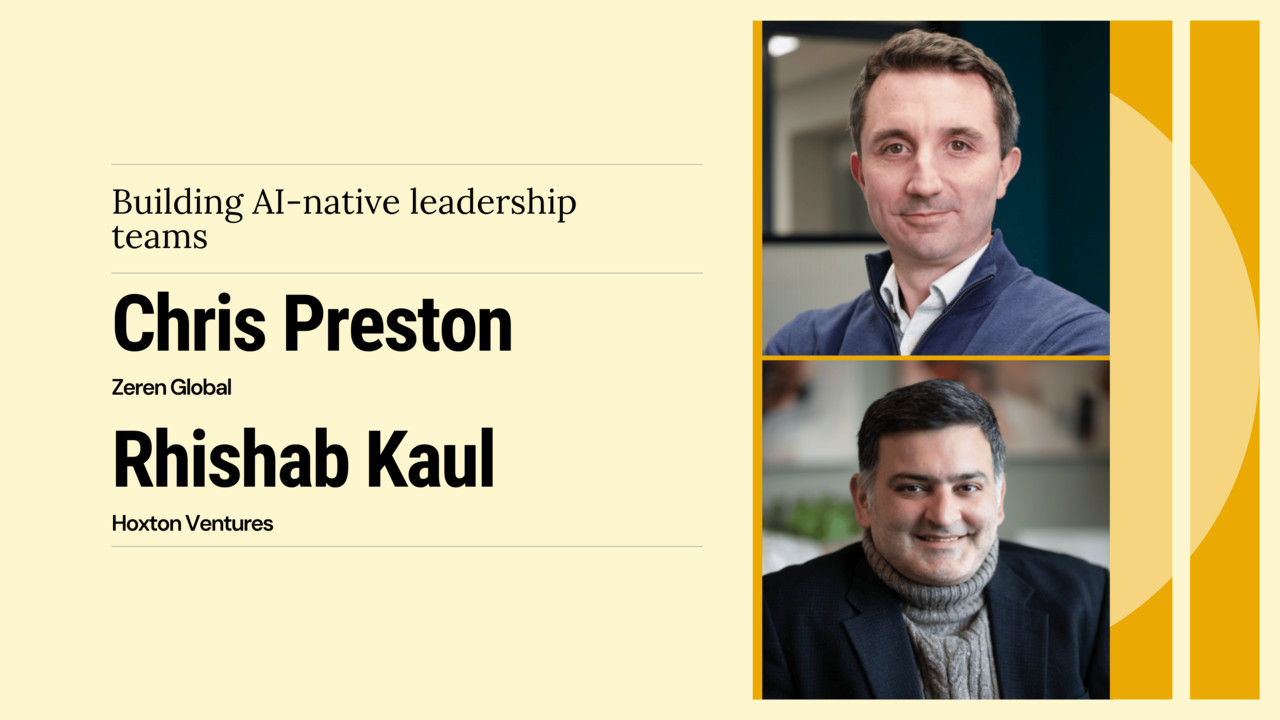
At the EUVC Summit & Awards Show in April 2026, Chris Preston, CEO at ZEREN, joined Rishabh Kaul, Venture Partner at Hoxton Ventures, to discuss how founders can assess that balance and how investors can recognise and spread effective practices across their portfolios.
AI-native is a behaviour, not a credential
AI use is already expected across product and technology teams. Chris said the bigger shift is demand extending into functions such as finance and people.
Founders, CEOs and investors increasingly want CFOs, chief people officers and other functional leaders who can apply AI within their own work.
“They have to really demonstrate the curiosity, the pace, the experimentation,” Chris said.
Candidates can learn the vocabulary of AI quickly. It is harder to imitate the habit of testing tools, changing workflows and developing an independent view of what the technology can and cannot do.
Rishabh described a reversal in how leadership teams learn. When he started his own company, his young founding team considered bringing more experienced people in as advisers. Today, he argued, an established executive may need exposure to younger people who are closer to how AI is being used.
Leaders expected to make decisions about AI need to remain close to that experimentation.
Make candidates show how they think
Chris shared the example of a company that asks finalists to write a debate document about the future of AI integration within their function. They then spend two hours discussing it with key stakeholders.
“It is much less about what you’ve done in the past,” Chris said.
The exercise shows how candidates think about the technology, respond to disagreement and connect new possibilities to operational realities. It also reveals whether they can contribute fresh or original thinking.
Rishabh pointed to another signal.
“The strongest signal is that you’ve actually been going and building stuff,” he said.
The tools do not need to be exceptional. Building with AI gives people first-hand exposure to what it can do, where it fails and how it might be useful.
Confident language about AI is a weak signal. Look instead for:
Something the candidate has personally built or changed
Lessons from poor outputs, limitations or failed experiments
A clear view of how AI could affect their function
An ability to defend and revise their thinking
An understanding of where human judgment remains essential
Hands-on use creates a basis for judgment that passive familiarity cannot.
Investors can spread effective portfolio practices
Rishabh said earlier-stage companies are often more willing to take risks and experiment. This can give investors examples from within their portfolios to share with other founders.
Not every leader needs to build AI tools themselves. Some roles need someone who understands what the technology can do and where its limitations lie, then uses that understanding to empower the team.
The investor’s role is to identify where AI adoption is producing better operating practices, connect those teams with less advanced portfolio companies and help each founder translate the lesson into a role-specific hiring brief.
This does not mean applying one profile across every company. Each role requires its own combination of experience, curiosity and direct exposure to the technology.
Curiosity cannot replace every kind of expertise
Some roles still depend heavily on experience.
Rishabh used fintech as an example. A company may need someone who knows the FCA or SEC and follows regulatory developments in areas such as stablecoins. AI fluency would strengthen that candidate, but it would not replace the underlying knowledge and relationships.
The trade-off is role-specific. Founders and investors should ask:
Which capabilities are essential from day one?
What would be the cost of weak domain expertise?
What would be the cost of slow AI adoption?
Which gaps can the existing team support?
Can a leader empower AI-native work without being the team’s most advanced user?
In a newly forming function, a fast learner may outperform someone repeating an established playbook. In a regulated or high-consequence role, deep expertise may need to come first.

Design uncertain roles before filling them
Sometimes the challenge is knowing what the role should be.
Chris said ZEREN is seeing more use of contract and interim experts for roles that remain poorly defined. An early-stage company or a business undergoing an AI transformation can bring someone in for six weeks or six months to shape the role and clarify what is needed before making a permanent hire.
This gives the company time to test the remit rather than recruit against a job description while the work itself is changing.
Interim leadership helps founders and investors determine what kind of permanent owner the business needs.
Hire for the spike the company needs now
Rishabh’s closing advice was to focus on what a candidate is exceptionally good at.
“It’s all about the spikes. Don’t bother about the downsides,” he said.
He immediately qualified that serious downsides still matter. His wider point was that founders can spend too much time looking for weaknesses in candidates who may have exactly the strength the company needs.
Do enough reference checks and you will find something, he argued. The more useful question is how good the person is at the capability they are being hired to provide.
That person may be right for the next couple of years without being right forever.
Founders should assess candidates against the company’s immediate needs, decide which gaps can be supported and recognise when the role may need to change.
Seven questions for the next leadership interview
What have you personally built or experimented with using AI?
What did you learn about what the technology can and cannot do?
How could AI change this function over the next two years?
How are you using AI in your own work or personal life?
Which parts of this role still require deep experience, specialist knowledge or relationships?
Is the role defined well enough to fill permanently or could an interim expert help shape it first?
What is this candidate exceptionally good at and is that what the company needs most now?
Calling yourself AI-native reveals very little. Ask candidates what they have built, let them debate how AI could affect their function and examine whether their understanding comes from direct experimentation.
For investors, the same signals can support leadership assessment and help transfer useful practices across a portfolio.
The hiring decision rests on finding the combination of curiosity and experience the role requires now.
Listen to the full conversation to inform your next leadership hire, with Chris Preston and Rishabh Kaul on interview design, AI experimentation and the roles where experience still carries more weight.