What makes a consumer company difficult to copy when technology is becoming easier to build?
Speed, funding and technical progress can create an early lead, but rarely lasting defensibility. The strongest companies use that lead to build advantages that become harder to replicate as they scale.
That is the focus of the second episode of the Consumer Tech Napkin, produced in partnership with True.
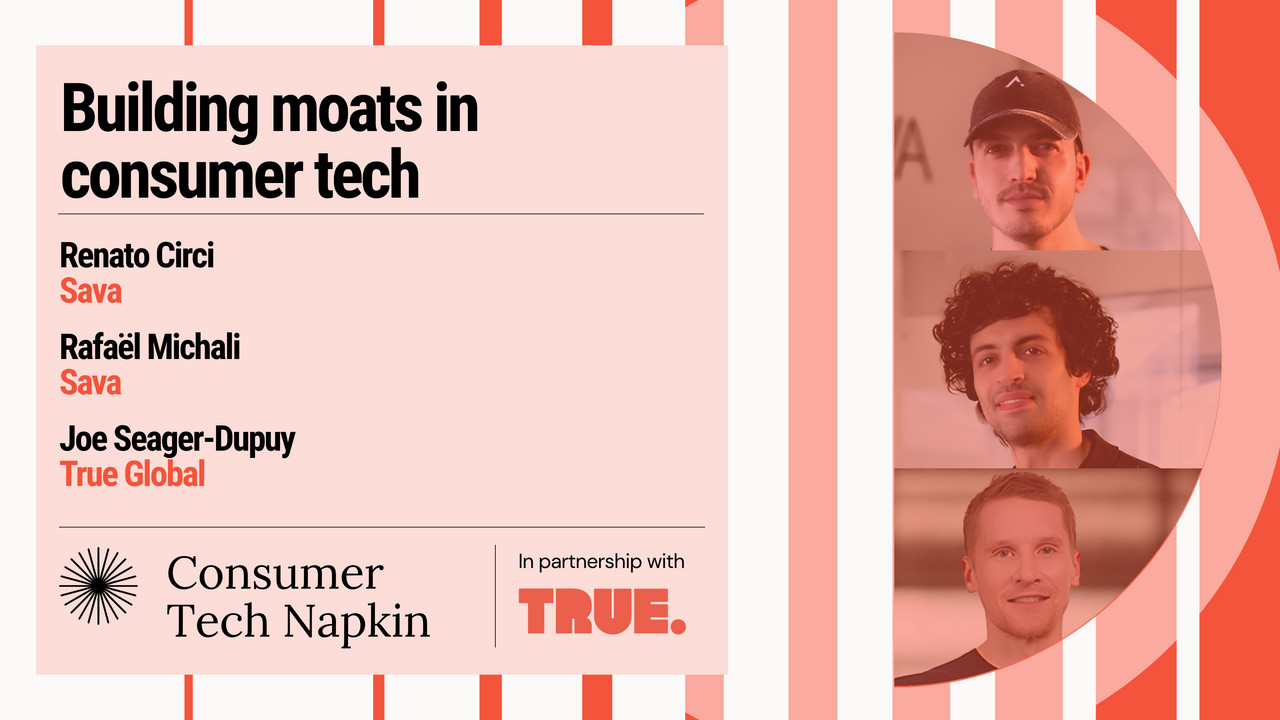
Hosted by Andreas Munk Holm, the conversation brings together Renato Circi and Rafaël Michali, Co-Founders at Sava, and Joe Seager-Dupuy, Director, Investment at True.
Sava is building a wearable biosensing platform that measures molecules beneath the skin continuously and sends the data to a user’s phone. The company develops and manufactures its sensors in-house in London, aiming to create a new foundation for personalised and preventative health.
A head start is not a moat
Early-stage companies do not begin with scale, distribution or network effects. Joe argued that they first need a compelling proposition, then a clear plan for how defensibility will strengthen over time.
Technical breakthroughs, patents and regulatory approvals can provide useful early protection, but they are threshold factors rather than lasting moats. Given enough capital, talent and time, competitors may eventually cross the same barriers.
As Joe put it, “They are a head start that gives you the right to start digging an actual moat over time.” The real source of defensibility is what the company builds with that head start.
Lasting moats compound
Joe distinguished between static and dynamic moats.
A static moat remains largely unchanged. A patent may protect a technology for a period, but it does not grow stronger as the company scales.
A dynamic moat deepens over time. Joe pointed to Spotify, whose early advantage came from securing music rights. As streaming became widely available, Spotify built further advantages through personalisation, user data, social features and creator tools.
Founders do not need to have their final moat fully built from day one. But they should understand what could compound and which early barriers will give them time to build it.
The bottleneck is where the value sits
When Renato and Rafaël began exploring preventative health, many companies were building software on top of existing monitoring devices. The common belief was that hardware would become commoditised and the best app would win.
They reached the opposite conclusion.
Software was becoming easier to build, while continuous access to biological data remained controlled by a small number of medical-device companies. The scarce resource was the ability to measure what was happening inside the body accurately and in real time.
“The interface with biology and the digital world was always going to be the bottleneck,” Renato said.
Sava therefore chose to build the sensing technology itself. That meant tackling a slower, more capital-intensive problem, but it gave the company control over the hardest part of the system.
The broader lesson is to find what is holding an entire market back. The strongest position may sit in the data, infrastructure or technical capability on which everything else depends.
AI makes proprietary data more valuable
AI may reduce the cost of building software, but, as Renato explained, it does not remove the need for differentiated inputs.
“Whatever AI insights or algorithms are going to build are only going to be as good as the data that we’re building on top of,” he said.
In healthcare, much of that data remains difficult to collect, fragmented across systems or captured only through occasional tests.
Sava wants to turn biological signals into continuous digital data. AI increases the value of that data because large, complex datasets can now be analysed in ways that would be impossible for one doctor or researcher.
The moat does not come from using the same models as everyone else. It comes from producing data that others cannot easily access.
A product should become a platform
Sava’s first challenge is monitoring glucose. Its longer-term ambition is to use the same sensing platform to measure several molecules.
Renato said the first application is the hardest because the company must establish the technology, prove the sensor works and navigate regulation. Once that foundation exists, adding further molecules should become easier.
Each addition could support new health applications and provide a broader picture of the body. Renato believes users will gravitate towards one platform providing several useful insights, rather than separate devices for every goal.
“You’re not going to go around with 20 different wearables that give you 20 different things,” he said.
The moat therefore depends not only on the first sensor or patent, but on what Sava can continue building on top of them.
The full experience matters
Medical-device companies have traditionally built around patients, clinicians and healthcare systems. Rafaël said this has often left the consumer experience behind.
Sava is trying to control the full journey, from opening the package to using the hardware and understanding the information in the app.
“ In the world of medical devices where there's a hardware element, the moat is actually the end-to-end experience,” Rafaël said.
This is not a cosmetic layer. It determines whether people understand the product, trust it and continue using it.
Strong technology may earn the right to enter the market, but the full experience determines whether users stay. In medical devices, that means treating hardware, software and interface as one product.
Patents should buy time for innovation
Patents remain important in medical technology, but Renato warned against treating them as the final source of defensibility.
A company that relies on intellectual property for too long can become slower to improve. When patents expire or competitors find alternative approaches, well-funded incumbents can catch up.
“You can’t hide behind that forever,” Renato said.
Sava sees patents and regulatory approvals as protection while it builds more durable advantages through additional sensing capabilities, proprietary data and a stronger consumer product.
Rafaël also described innovation itself as a moat. Early protection should create time and space to keep improving, not become a reason to stop.
Europe’s talent is an advantage
Renato described Europe as a strong source of scientific and engineering talent, supported by leading universities and research institutions.
“Europe is an amazing powerhouse of scientific innovation,” he said.
The constraint is capital. European investors can still be cautious around companies combining hardware, science and long development timelines, particularly at later stages.
Rafaël added that Europe has fewer people who have already scaled businesses of this kind. Founders often need to develop that knowledge themselves.
That makes the journey harder, but can also produce capabilities that are difficult to copy. Europe’s scientific base and lower competition for specialist talent can become a meaningful deep-tech advantage.
The best moats often begin as non-consensus ideas
For years, consumer hardware was widely seen as too expensive and difficult for venture-backed startups. Sava began building its platform before AI made proprietary hardware and data fashionable again.
Renato said founders can sometimes feel like they are the only people who understand why their approach will become valuable. That is not always evidence that they are wrong. “The best moats typically are very non-consensus,” he said.
Consumer Tech Napkin series
Watch other parts of the Consumer Tech Napkin series, produced in partnership with True:


