An industrial startup can prove its technology and still struggle to scale if its first plant is financed in a way that limits the company’s future. Founders need to decide early which risks belong with venture investors, which can be financed at the project level and what the company must retain to build the next facility.
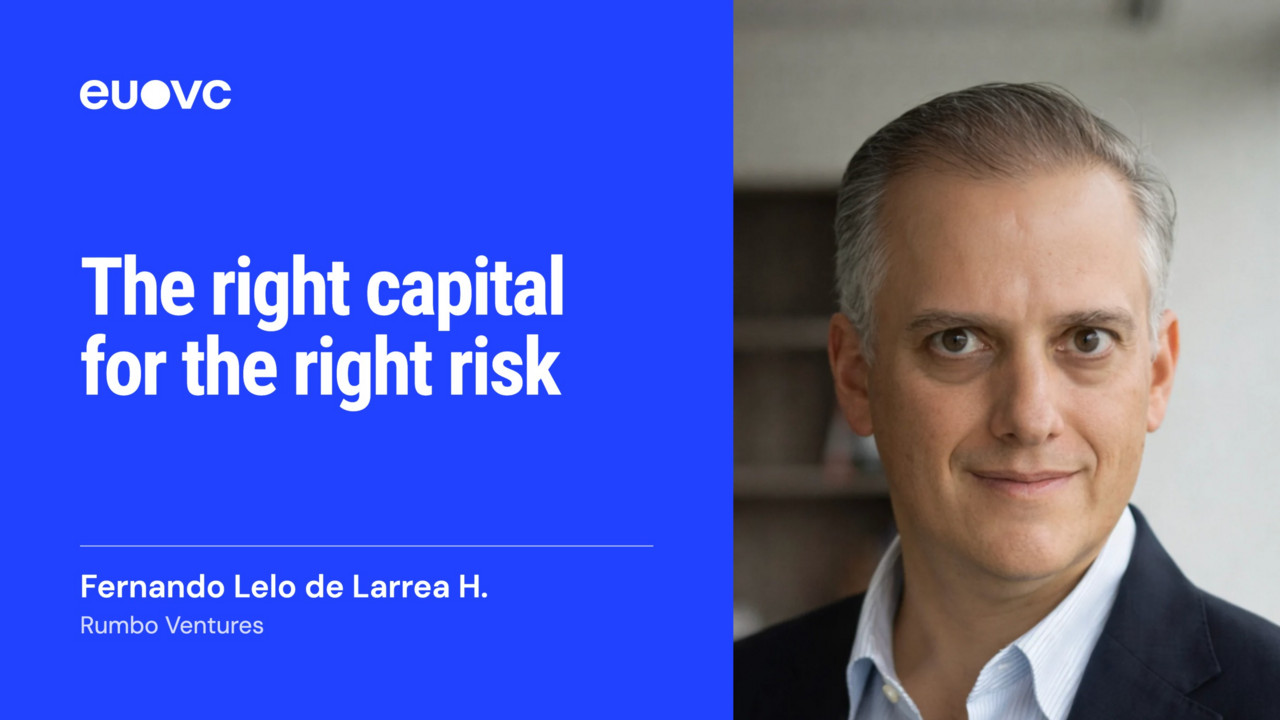
In this EUVC episode, Fernando Lelo de Larrea H., Founder and Managing Partner at Rumbo, explains how to design that capital architecture around the assets a company needs to build and the risks each financing partner can carry.
Start with what needs financing
A venture round can fund the team, engineering and work needed to prove a technology. Building a commercial facility may require a much larger sum, with a different risk profile and different investors.
Fernando points to Karbon, a company he invested in early. He says it needed £10 million to reach a stage that included detailed engineering and feasibility work. Its planned first facility, by contrast, would cost more than £500 million to build. For Fernando, that gap illustrates why a succession of venture rounds alone may not provide the right path to deployment.
His starting point is a project finance principle:
“Every risk should sit with whomever is best able to carry it.”
The practical question is what needs financing and which source of capital is suited to it. Venture investors may be able to take technology and execution risk; project investors and lenders will also need to assess the economics and risks of a specific facility.
Keep future growth in the company
Fernando suggests separating the assets and agreements that support an individual project from the capabilities that allow the company to create more projects.
That can mean using a special purpose vehicle, a separate entity that holds a facility, to bring in project equity and debt. The company, meanwhile, may retain intellectual property, talent and engineering capabilities that can generate value across multiple facilities.
The distinction is useful because the two levels need different things. A project financier wants confidence in the cash flows available to repay financing over the life of that facility. A venture investor is also backing the company’s potential to expand beyond it.
“Everything that is expansion, that is future paths, that is additionality to your revenue stream goes at the company level.”
The exact boundary depends on the business and its financing agreements. Fernando’s test is whether the structure supports both a financeable project and a company capable of creating value beyond that project.
Make the first project a template
The first facility is often the hardest to finance: lenders may be unfamiliar with the technology and uncertain about its future cash flows. Fernando argues that founders should design it with subsequent facilities in mind.
He uses Circular Materials, which recovers valuable metals from industrial wastewater, to illustrate a different model from Karbon’s large first facility. Its installations are smaller, so Fernando sees potential in building a portfolio of projects. As the technical solution and financing structure become more standardised, later facilities may become easier and less costly to finance.
That outcome is not automatic. A first project still needs terms that leave the company room to build the next one.
Check the terms before they constrain growth
Fernando has seen financing arrangements give a funder of one facility influence over future projects. That can create tension: the funder is focused on repayment from its facility, while the company needs freedom to expand.
Grants can also bring obligations worth examining early. Fernando describes cases where jurisdiction requirements could complicate a later restructuring, or where service and reporting commitments consumed founder time. Those conditions do not make grants inherently unsuitable, but they should be weighed against the intended financing path.
A practical test for founders
Before agreeing to the next round or project financing, take these questions to your investors and advisers:
What needs financing? Separate company development costs from the assets and agreements needed for each facility.
What risk is still outstanding? Identify what has been demonstrated and what a prospective investor or lender would still need to assess.
What stays with the company? Check whether it retains the capabilities and rights needed to develop future projects.
Can the next facility follow? Review whether project-financing rights, grant conditions or investor terms could restrict where or when you build again.
Are investors aligned on the destination? Discuss the intended path to an exit and the time horizon each investor has in mind.
Use the answers to work backwards from the first commercial facility to the decisions you need to make now.
Listen to the full episode on Spotify to hear Fernando’s examples and financing advice.
This episode was produced in partnership with Rumbo.


