The real advantage of corporate venture capital is the operating system behind the cheque.
A well-run CVC can connect startups with business units, technical specialists, production expertise, corporate customers and other investors while taking a longer-term view. Delivering that value consistently requires a clear mandate, aligned stakeholders and a durable partnership model.
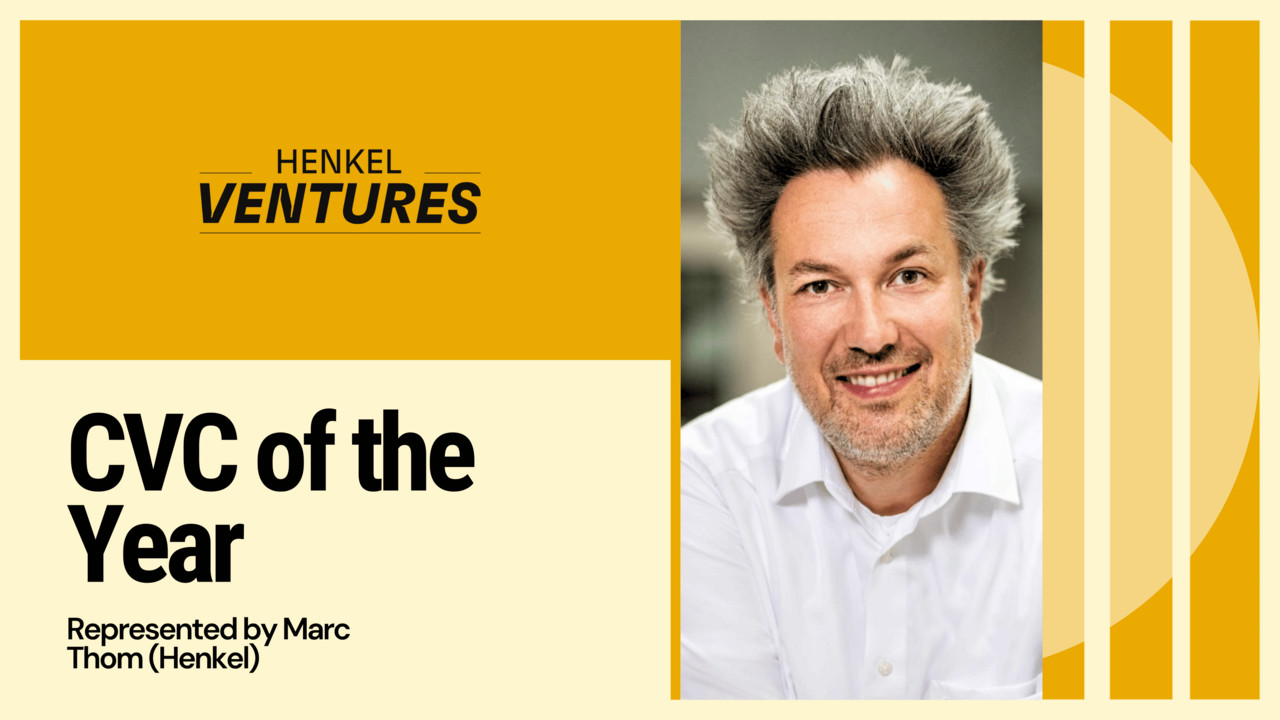
Marc Thom, Head of Henkel Ventures, shared this perspective after accepting the Corporate Venture Capital of the Year award at the EUVC Summit & Awards Show.
The award recognises Europe’s most impactful corporate venture capital arm based on investment activity, innovation, impact and contribution to the CVC ecosystem.
The capabilities behind the capital
Thom has worked in the industry for 15 years, including time on the traditional VC side. Henkel Ventures is the corporate venture capital arm of Henkel, the company behind Loctite, Schwarzkopf and Persil.
With €300 million in assets under management, Henkel Ventures invests from early stage to Series B, with tickets ranging from €0.5 million to €5 million. Its geographically agnostic strategy focuses on sustainovation and digitalisation.
For Thom, a strong CVC converts corporate capabilities into practical support:
Access to business units and technical specialists
Sourcing, purchasing and manufacturing expertise
Support with facilities and automated production lines
Introductions to corporate partners and professional VCs
Industry insight for due diligence, pricing and market validation
Henkel Ventures can connect companies with Henkel’s two business units, Henkel Consumer Brands and Henkel Adhesive Technologies, and more than 3,000 R&D experts.
Thom noted that professional VCs already approach corporate investors to assess technologies, validate assumptions and help portfolio companies scale. Henkel’s nearly 150 years of industry experience can open further doors.
Strategic value must be designed
Corporate resources only become useful when a CVC has the mandate to activate them.
When Henkel Ventures developed its second fund, the team created an investment proposal statement, a partnership proposal statement and an investment committee charter. These defined its strategy, partnership model, decision process and measures of success.
“What are we going to do? Why are we doing it and how are we doing this and when are we successful?” Thom said, describing the questions the team aligned on with Henkel’s stakeholders.
The process took around a year, but it established a shared basis for consistent decisions.
“It’s a marathon, not a sprint.”
Thom also emphasized the value of combining external investment experience with internal knowledge of the company and its decision-making processes.
A longer horizon still requires alignment
CVCs often invest from a corporate balance sheet, reducing the pressure to exit as a conventional fund approaches the end of its life. As Thom put it, “you have the longer breath.”
Corporate priorities can still change and venture programmes can close. Thom argued that traditional funds face similar uncertainty, pointing to VCs that have changed sectors, revised their investment principles or entered fields without established teams.
A longer horizon therefore needs governance strong enough to withstand shifting priorities.
Europe’s industrial knowledge is an advantage
Thom sees particular potential for European corporate capital in chemistry, complex engineering and semiconductors. He cited Siemens and Bosch as examples of engineering strength and highlighted the semiconductor expertise within Merck’s venture team.
This knowledge becomes increasingly valuable as AI moves into specialist industrial applications. Europe already holds many of the domains where emerging technologies need to be applied.

Thom described an undisclosed Henkel Ventures investment in an R&D AI company that, in his assessment, has more revenue and substance than a US counterpart but communicates its strengths less confidently. Europe’s opportunity is to tell stronger stories grounded in technical and commercial performance.
“We need to be more proud about what we can do.”
A practical test for CVCs
CVC teams can test whether their strategic value proposition is operational by asking:
Access: Which corporate capabilities can we offer each portfolio company?
Ownership: Who is responsible for activating them?
Alignment: Do the investment team, business units and senior stakeholders share the same mandate?
Measurement: What does success look like for both the investment and the partnership?
Durability: Can the strategy withstand leadership changes and shifting priorities?
Clear answers turn corporate depth into a genuine investment advantage. Vague answers leave it as a promise.