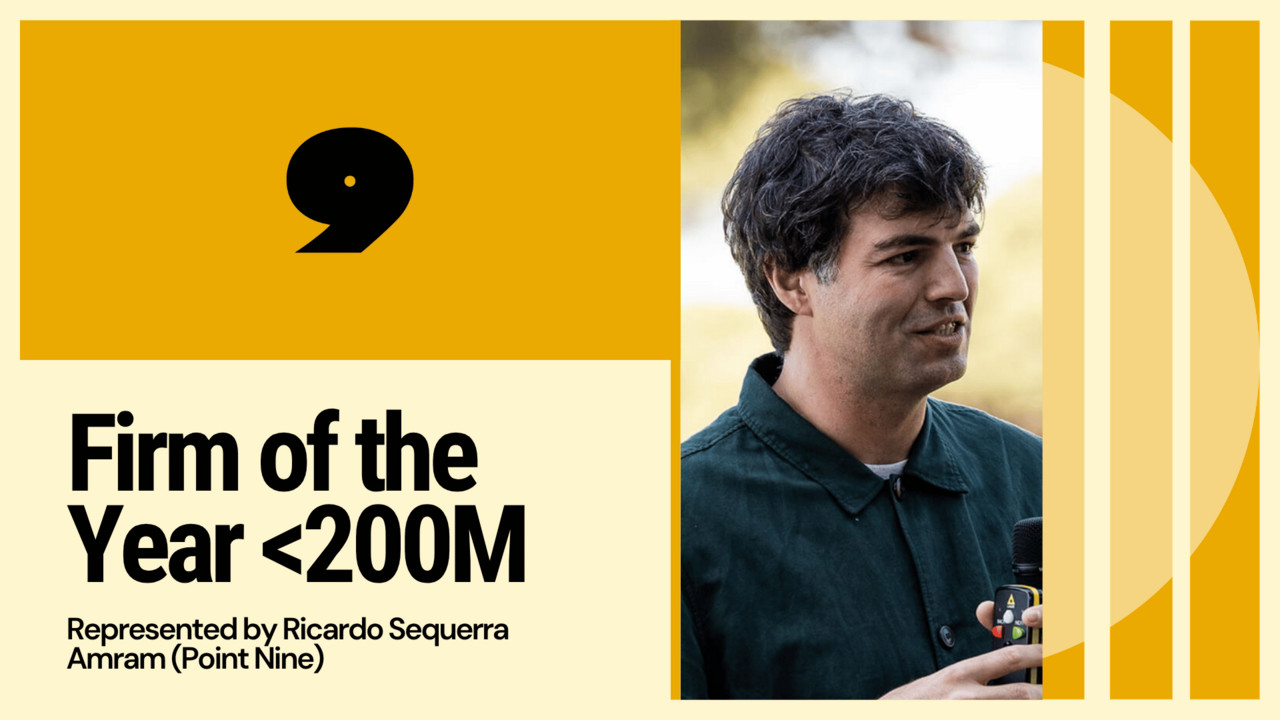
The EUVC Firm of the Year award recognises how a firm performs across its portfolio, founders, LPs and the wider venture ecosystem, not returns alone.
Point Nine received the 2025 award in the under €200 million category, with Ricardo Sequerra Amram, Partner at the firm, accepting on its behalf before joining a conversation at the EUVC Summit & Awards Show 2026.
Built around seed
Point Nine is a thesis-driven early-stage venture firm based in Europe and investing globally. Its original model was built around a gap its founders saw in European venture: investors were willing to participate in seed rounds, but fewer were prepared to lead them.
The firm also chose to invest globally from the start. Its early focus on B2B SaaS and marketplaces led to investments in companies including Zendesk, Contentful, Algolia, Delivery Hero and Revolut.
That early-stage focus remains central to how Point Nine operates today.
Low volume, high conviction
Point Nine operates with four equal partners, with each making around two or three new commitments a year.
Ricardo describes the model as low volume and high conviction. Keeping the number of investments limited gives each partner more time to understand the companies closely and work directly with founders.
The firm has also deliberately limited its expansion into later-stage investing.
Ricardo describes Point Nine as having “anti-scaling mechanisms” by design, arguing that moving into much larger checks would dilute the work required to identify outlier potential at pre-seed and seed.

Staying focused while the thesis evolves
Point Nine became closely associated with B2B SaaS, but Ricardo argues that investing at seed requires continually looking for what is genuinely new.
That has broadened the firm’s focus into AI, hard tech and robotics, while retaining a strong software lens. Ricardo describes AI not simply as another layer of software, but as a technology enabling different kinds of businesses.
For Point Nine, the stage has remained consistent while the technologies and markets it explores have changed.
Looking for the non-obvious founder
The conversation closes on how Point Nine identifies founders before an opportunity becomes obvious.
Ricardo describes a sense of “magnetic pull” around some founders: people who can attract talent, follow-on capital, customers and partners. But he is clear that this is only one signal.
Point Nine looks more deeply for three qualities: insight, obsession and taste. Rather than relying only on conventional CV signals, Ricardo looks at where a founder’s insight comes from, how deeply they understand the problem and whether they have developed strong intuition about how a product should be built.
Founder profiles change as technology changes. Ricardo’s view is that the work at seed remains more consistent: spend enough time with founders to understand what is actually there.