Europe’s quantum opportunity will be shaped by the companies building its hardware before the market reaches certainty.
Finland-based IQM Quantum Computers shows what that requires: control the core technology, turn research into working systems and secure enough capital to build physical infrastructure at global scale.
That work took IQM from an Aalto University research group to the public markets. In July 2026, IQM became Europe’s first publicly listed quantum company through a SPAC merger that valued it at approximately $1.9 billion, according to TechCrunch.
The transaction confirmed that IQM had crossed the unicorn threshold as it ended its private-company chapter. It also brought the industry’s uncertainty into focus: the company’s prospectus cautioned that large-scale commercial traction for quantum computing might never materialise.
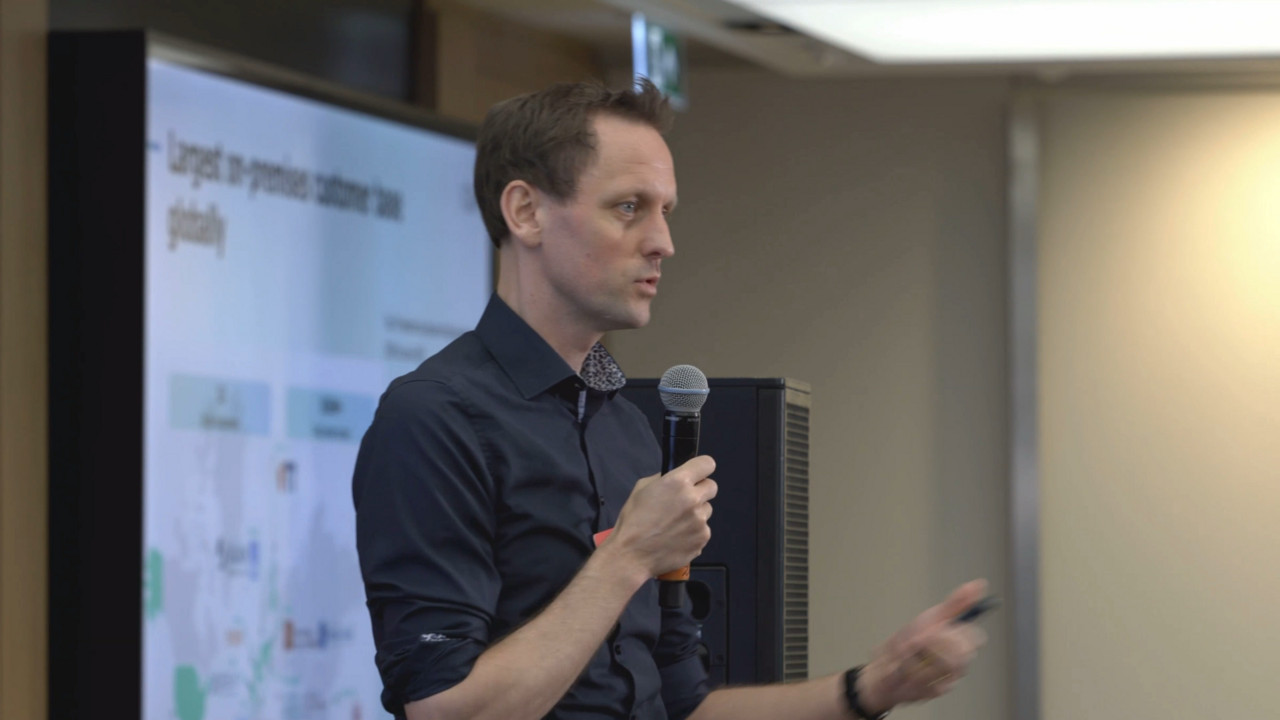
Speaking at EUVC Summit 2026, Jan Goetz, CEO & Co-Founder of IQM Quantum Computers, explained the company-building decisions behind that journey.
Build for problems classical computers cannot reach
Classical computing is approaching physical and economic constraints. More computing power requires more processors, larger data centres and greater energy consumption.
Some important problems remain beyond the practical reach of those systems. Jan used fertiliser production as one example. Accurately simulating its chemical properties, he said, could require a classical computer with more transistors than there are atoms in the universe.
Drug discovery presents a similar challenge. Pharmaceutical companies invest heavily in research and development, yet accurately simulating new compounds remains computationally difficult.
Quantum computers approach these calculations differently.
“We need computers that compute differently.”
The state space a quantum system can represent grows exponentially with the number of qubits. This could allow quantum computers to tackle specific classes of calculations that conventional systems cannot perform efficiently, with potential applications across pharmaceuticals, chemicals and materials.
The timeline remains uncertain. IQM is developing its technology and customer base without knowing exactly when quantum computers will outperform classical systems across a broad range of commercially valuable tasks.
That uncertainty makes control over the underlying technology more valuable.
Own the infrastructure your market will need
IQM began in 2018 as a spinout from Aalto University in Espoo. Its early business plan was essentially a list of equipment the researchers wanted to buy.
The company later raised €11.2 million in seed funding, which IQM describes as the largest seed round raised by a Finnish startup at the time.
After securing its first investment, IQM moved into an office without the cooling infrastructure required to operate a quantum computer.
The team rented the parking area underneath, drilled holes through the floor and installed a compressor in the basement to produce cooling water.
The improvised setup helped IQM move quickly. It also exposed the distance between demonstrating research and delivering dependable hardware.
“At some point you have to do things properly.”
IQM went on to build its own chip-design tools, quantum chips, factory, assembly line and cloud infrastructure. Its factory uses 200-millimetre silicon wafers and, following an expansion, has roughly 1,000 square metres of clean-room space.
Vertical integration makes the business more capital-intensive. It also gives IQM control over the component Jan expects to constrain the market.
“Hardware is really the limiting factor.”
AI has already shown how shortages of advanced chips can restrict an entire computing market. IQM is preparing for a similar dynamic in quantum, where manufacturing capacity and the ability to deliver working systems could become decisive.
Use deployment to turn research into evidence
IQM sells complete quantum computers to data centres and supercomputing centres. It also sells computing time through the cloud.
By August 2026, IQM reported 26 systems sold and 17 delivered, including its first US delivery to Oak Ridge National Laboratory.
Jan also said four of the world’s ten highest-ranked supercomputing centres were integrating IQM technology.
Those deployments give IQM more than sales. Each working system builds manufacturing experience, operational knowledge and customer relationships that would be difficult to reproduce quickly.
Jan argued that Europe already holds a specific advantage here.
“In the deployment of quantum computers, we are really strong.”
His assessment was that more quantum systems were deployed in European computing centres than in the US. Jan made the same comparison in a separate interview with Vsquared.
The comparison is specifically about deployment, one layer of the wider quantum market. An independent like-for-like count is not publicly available, but Europe has built a measurable shared infrastructure: EuroHPC is integrating six quantum computers across Czechia, Germany, Spain, France, Italy and Poland. That deployment gives European researchers and companies a growing base of systems, operating experience and user access.
Access global capital without relocating the company
Building quantum hardware requires substantial capital long before the market reaches mass adoption.
IQM has combined European public support, institutional investment and international venture capital to finance its expansion. It has also established operations in the US and deployed technology there.
The company’s headquarters, research base and much of its team remain in Europe.
Jan described the strategy in four words:
“No flip to the US.”
Accessing US customers and capital does not require transferring the company’s centre of gravity across the Atlantic.
IQM has used different markets for different advantages: Europe for research, specialist talent and industrial infrastructure, then global capital markets to finance scale.
That creates a practical diligence test for other European deep-tech companies.
Founders should identify the capability their future market cannot operate without and determine whether they can own it before demand becomes obvious.
Investors should assess whether today’s deployments are creating a durable operational advantage or merely demonstrating interesting technology.
Listen to the full conversation with Jan Goetz for the decisions behind IQM’s hardware, infrastructure and global capital strategy.