Consumer companies compete for something scarce: people’s attention. Strong technology can help a team build quickly, but earning a place in someone’s routine requires a deeper understanding of what they value, how they behave and why they return.
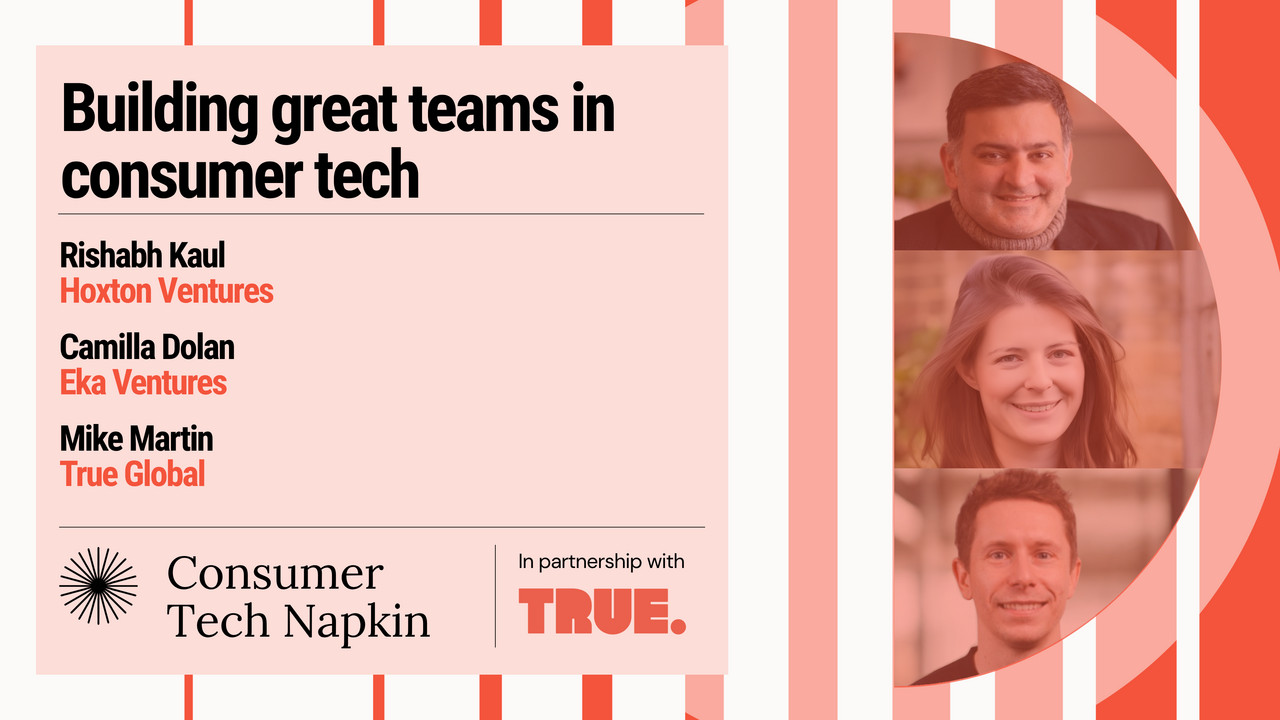
This is the focus of Episode #3 of Consumer Tech Napkin, produced in partnership with True, where host Andreas Munk Holm is joined by Rishabh Kaul, Venture Partner at Hoxton Ventures, Mike Martin, Director, Investment at True, and Camilla Dolan, General Partner at Eka Ventures.
Every great team needs a superpower
Rishabh begins with a simple test: “You want some sort of a superpower in the team.” That strength might sit in distribution, brand, product or another capability, but it should give the company an early reason to exist in a crowded market.
For Camilla, that superpower is more specific. “Our superpower is customer obsession,” she says. Before Eka even speaks to a founder whose product is live, the team examines customer reviews for signs that the founder goes beyond what is expected.
She points to founders who continue answering reviews, speaking directly with users and participating in the communities around their products long after the company has grown. What she looks for are “brands and founders that create this emotion in their end consumers”.
Those behaviours reveal whether customer focus is an operating principle or simply part of the company’s marketing language.
Mike agrees that consumer teams need to “delight users” and “go beyond their expectations”. In consumer markets, a product is not only competing with direct alternatives. It is competing with work, family, entertainment and every other demand on a person’s time.
That makes the bar unusually high. A founder’s understanding of the customer influences what gets built, which details receive attention and how quickly the team responds when something is not working.
A strong personal connection to the problem can also help founders persist. Mike distinguishes between missionaries, who feel closely attached to the mission, and mercenaries, who may simply recognise a commercial opportunity.
Both can build companies, but a founder with a deeper commitment may be more likely to continue when the journey becomes difficult and better able to persuade talented people to join.
Distribution is part of the product challenge
A great consumer product still needs to reach people. As Rishabh puts it, “The product can be great, but you need to be able to take it to the masses.”
He therefore looks for someone in the founding team, ideally a founder, who understands distribution at an unusually deep level. That does not always mean organic growth. Paid acquisition can become a genuine advantage when it is treated as a craft rather than outsourced as a generic marketing function.
Rishabh describes a small consumer wellness company that reached roughly $10 million in monthly revenue with a four-person internal team, largely because its founder had developed exceptional expertise in paid social.
The lesson is not that paid marketing can rescue a weak product. The company still needs retention, positive word of mouth and sound unit economics. But a capability that many teams treat as interchangeable can become a defining strength when someone understands every lever in detail.
The team must evolve before growth exposes its weaknesses
Early employees often succeed through adaptability, energy and belief in the founder. As the company grows, the requirements change.
Rishabh argues that companies approaching Series A should begin hiring people who have experienced the next stage of development. Consumer companies can scale quickly, leaving little time to learn operational discipline after the pressure has already arrived.
Camilla has seen how dangerous that gap can become. A business may reach £10 million in revenue with limited financial infrastructure, but the journey towards £30 million or £100 million requires much tighter control of operations, inventory, logistics and finance.
Mike looks for founders willing to respond before those weaknesses become critical. One of his central questions is: “Do the founders have the self-awareness and enough of a low ego to hire people who are better than them?”
He also considers who they have persuaded to join, what those people gave up to take the role and whether the founders can have difficult conversations when a hire or co-founder relationship is no longer working. The ability to confront those situations early becomes more important as the organisation expands.
AI changes the pace, not the fundamentals
AI is making it easier to build prototypes, analyse feedback, create marketing material and run experiments. Mike believes it is becoming increasingly difficult for a pre-launch consumer founder to justify having nothing tangible to show potential users or investors.
Camilla sees a new generation of AI-native entrepreneurs who can enter the market and iterate faster with fewer resources. But she also warns that these tools “still don’t mean that you are providing a product or a service that customers love”.
AI can accelerate awareness and performance marketing, but it does not automatically create trust, brand affinity or long-term product love.
Rishabh suggests that investors should therefore look for “domain depth and not domain expertise”. A founder may not have spent 20 years in an industry, but they should have immersed themselves deeply enough to form informed opinions and understand the market’s unresolved problems.
This also changes how teams hire. Specialist knowledge remains critical in some roles, but fast-changing product and technology functions increasingly reward curiosity and a steep learning curve. The question is not only what someone already knows, but what they have learned in the past three, six or nine months.
Customer obsession remains the final test
AI gives more teams access to similar tools. What differentiates them is how they use those tools to understand customers and act on what they learn.
“The quicker you can ship product, the quicker you can get feedback, the quicker you can iterate, then the better chance you have,” Mike says.
Yet speed without curiosity is not enough. He describes dismissiveness towards customer feedback as the opposite of what True looks for, while Camilla says any indication of “disrespect towards your customer” is enough for Eka to walk away.
Rishabh uses a related test: does he leave each conversation having learned something new, and does the quality of the discussion improve from one meeting to the next?
As the discussion makes clear, the way consumer teams build is changing fast. What makes them great remains remarkably consistent: customer obsession, a distinctive strength, the humility to keep learning and the ability to turn that learning into action.
Consumer Tech Napkin series
Watch other parts of the Consumer Tech Napkin series, produced in partnership with True:


