As AI compresses product development cycles, the advantage in consumer tech is shifting from what you can build to how quickly and intelligently you can learn from users.
That shift is the focus of Episode #4 of Consumer Tech Napkin, produced by EUVC in partnership with True.
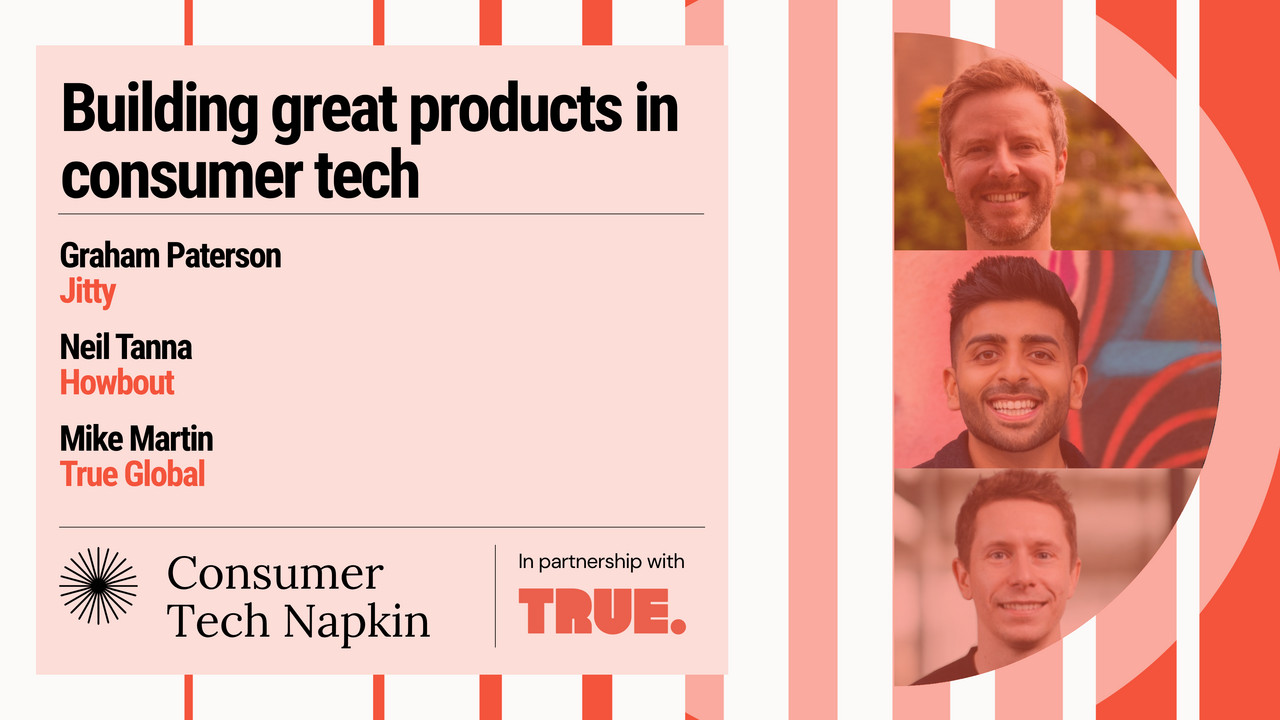
Host Andreas Munk Holm speaks with Neil Tanna, Co-Founder and CEO of Howbout, Graham Paterson, Co-Founder and CEO of Jitty, and Mike Martin, Director, Investment at True.
Howbout is a shared social calendar with more than seven million users across 125 countries. Jitty is a search engine for homebuyers, while Mike adds the investor perspective from True.
The moat has moved
The starting point for the discussion is: software has always been replicable. AI has merely made that reality much harder to ignore.
“Features have never been difficult to copy. AI hasn’t changed that,” Neil says. “It’s just made it so much more obvious because the speed at which it can be done is so much quicker now.”
In his view, lasting advantage increasingly comes from three places: distribution, genuine user love for the product or brand and the company’s learning loop. A competitor can copy a feature, but it cannot immediately copy what you have learnt from your users.
Graham reaches a similar conclusion. Consumer companies are always building under uncertainty, so the teams most likely to win are those with systems that help them discover the right solution fastest.
The founding idea is only one part of the equation. As he puts it, the entrepreneurial skill is not simply having the insight but “being able to turn it into something”.
Distribution remains central, but it cannot compensate for a weak experience. Mike cautions that “distribution is great, but it’s also pointless if the product isn’t great”. A company may reach a large audience through paid acquisition, a celebrity partnership or a viral moment, but that advantage disappears if people try the product and never return.
The strongest consumer companies therefore combine an effective route to users with a product worth returning to and a team capable of adapting as channels and behaviours change.
Experimentation starts with a question
Learning quickly does not mean releasing features indiscriminately. Neil draws a clear distinction between a genuine experiment and “shipping and hoping”.
At Howbout, product work begins with quarterly goals around growth, monetisation and retention. Teams identify the metrics they want to move, form hypotheses around them and only then decide what features or tests could prove or disprove those hypotheses.
That order matters. Starting with the hypothesis keeps the team focused on the outcome rather than becoming attached to a feature. Another intervention may turn out to be a better way of achieving the same goal.
Graham applies the same principle to both short experiments and longer-term product bets. Framing the work as a question keeps teams aligned: “If we do this, we think this will happen. Is that right?” It gives researchers, designers and product teams a specific uncertainty to resolve rather than a broad idea to investigate.
Not every important decision can be validated in two weeks. Jitty distinguishes between measurable experiments and bets that may take months to assess.
Howbout uses the idea of “remarkability” for lower-confidence initiatives that could have an outsized effect. The challenge is to combine disciplined testing with enough conviction to pursue ideas that incremental optimisation would never uncover.
Build a system for taking risk
Howbout’s scale allows it to treat geography as part of its experimentation infrastructure. Higher-risk changes are often introduced in Australia, an English-speaking market with behaviours similar to other Western markets but which is less strategically important to the company.
More controlled, high-volume tests can run across US states with similar demographics while the UK, where Howbout’s network is densest, is generally protected from the riskiest changes. Experiments have a primary success metric and a guardrail metric so that an improvement in something like conversion does not quietly damage retention or word of mouth.
The system does not eliminate risk. It creates a more deliberate way to absorb it.
Graham argues that this is partly cultural. As companies grow, they can become increasingly reluctant to disturb what already works. Maintaining the capacity to take meaningful product bets requires leaders who remain comfortable with uncertainty even when there is more to lose.
AI accelerates learning, but taste still matters
AI is already helping Howbout ship and analyse tests faster. Neil says the company increasingly runs multiple variants at once and, for sufficiently defined problems, AI can generate copy, run experiments and analyse which performs best.
Design is different. Neil argues that it still requires human taste. Howbout’s social calendar has become distinctive partly because it does not look like Outlook, Apple or Google Calendar. Giving that interface to AI and simply asking it to improve it could push the product back towards the conventions of everything that already exists.
Speed is useful only if it does not erase what makes the product distinctive.
Scale then compounds the learning advantage. “The learning rate is a function of your audience size,” Neil explains. With seven million users, Howbout can detect relatively small effects quickly. A company with only a few thousand users may need much longer to reach the same confidence, by which point the market may already have moved.
AI lowers the cost of experimentation for everyone, but existing user relationships, product taste and accumulated learning remain much harder to replicate.
That may be the defining challenge of building great consumer products today: using technology to move faster without allowing speed to replace judgement.
Consumer Tech Napkin series
Watch other parts of the Consumer Tech Napkin series, produced in partnership with True:


